Travel Workouts for Men: How to Stay Fit and Lean on the Road
If you’ve ever come home from a 2-week vacation, looked in the mirror and felt like you lost half your muscle, you’re not imagining it. You really do look smaller. But you didn’t lose anywhere near half your muscle, and part of what you’re seeing is water.
Your muscles store carbs, and they hold on to water along with them. When you stop training for a week or two, they hold less of both, so they look flatter. You do lose a little real muscle too, especially if you’ve been training hard for years. But your strength mostly holds, and once you start training again, the water comes back quickly and so does the muscle.
That doesn’t mean you should spend the whole trip on a beach chair. It means your goal on the road is different from your goal at home. At home, you’re trying to build muscle. On the road, you’re trying to keep it, and keeping it takes a lot less than you think.
It also takes a lot less equipment than you think. You don’t need a gym, a membership, a fancy home gym setup or even a basic set of weights. All you really need to get a decent workout is you, and if you’re creative enough, you could probably get one done in a broom closet. So unless your health is bad or an injury keeps you from walking or lifting anything, the only thing standing between you and a workout on the road is motivation.
In this post, we’ll look at why a short trip barely touches your muscle and how to make a bodyweight workout hard enough to count. Then I’ll walk you through 6 exercises you can do with nothing but a bed and a backpack, a 25-minute workout and a 10-minute version for packed days, and a few tips for staying on track and eating well while you’re away.
You won't lose muscle on a short trip
Researchers have actually tested how little training it takes to keep the muscle you’ve built, and the research gives you a pretty clear answer.
A team led by Scott Bickel had adults lift 3 days a week for 16 weeks, and then cut their training way back for the next 32 weeks. One group stopped completely. The other groups kept training, but much less than before. The young adults in the smallest group did just 1 set per exercise, 1 day a week, and they kept the muscle they had built. The older adults in the study didn’t do as well on the reduced plans and lost some of their muscle.
In 2021, a review led by Barry Spiering pulled together the research on how little exercise it takes to stay in shape, and it landed in the same place. Younger lifters kept their strength and muscle on as little as 1 session and 1 set per exercise a week. Older lifters may need 2 sessions a week and 2 to 3 sets per exercise. The review also found that the one thing you can’t cut is how hard you work. You can do a lot fewer sets, but the sets you do still have to be hard.
Even taking time off completely doesn’t cost as much as it looks like in the mirror. A team of Japanese researchers led by Riki Ogasawara had young men bench press for 24 weeks, and one group took 3 weeks off twice along the way. That group lost a little muscle during each break, gained it back once they started training again, and finished with about the same results as the group that never stopped. Those men were new to lifting, so the study isn’t a perfect match for a guy who’s been training for years, but it points the same way as the rest of the research.
So here’s what that means for your next trip. If you’re under about 60 and you’re gone for a week or two, 1 or 2 short, hard workouts a week will hold on to what you’ve built. If you’re older, plan on 2. And if you’re gone longer than about 3 weeks, the same 1 or 2 workouts a week still do the job, but the exercises will start to feel easier, so you’ll need the section on keeping it hard later in this post.
Why most hotel room workouts don't count
If all you really need is you, why do so many hotel room workouts feel like a waste of time? It’s because they’re too easy, especially for your legs. Your legs carry your whole body around all day, so 20 bodyweight squats barely register.
Try this the next time you’re home. Do 20 regular squats and notice how you feel at the end. Then rest a minute and do 8 slow split squats with your back foot up on the couch. You’ll feel the difference within the first few reps.
That difference is what this whole post is built on. Your body is all the equipment you need, but you have to use it in a way that makes every set hard. In this post, hard means you end each set with only 1 or 2 clean reps left in you. Without weights, there are 3 ways to get there.
First, train one side at a time. When one leg has to do the work of 2, your bodyweight gets a lot heavier in a hurry.
Second, slow down on the way down. Take about 3 seconds to lower yourself on every rep. Your muscles stay under load for longer, and a set of 12 that used to feel easy starts to feel hard.
And third, pause at the bottom. Holding for 1 second at the hardest point of the rep takes away the bounce that makes bodyweight exercises easier than they look.
If those 3 still aren’t enough, there’s a fourth option you’re already carrying, which is your backpack. Fill it with whatever’s heavy, like water bottles and the shoes you overpacked, and you’ve got a dumbbell.
Now let’s jump into the 6 exercises. Each one shows you how to make it harder once it gets easy, and none of them needs anything you can’t find in a hotel room.
2-minute CONFIDENCE QUIZ
Find out what's holding you back: your body, your style, or your dating life.
9 questions. You get a score for each and the one area to work on first.
1. Push-up
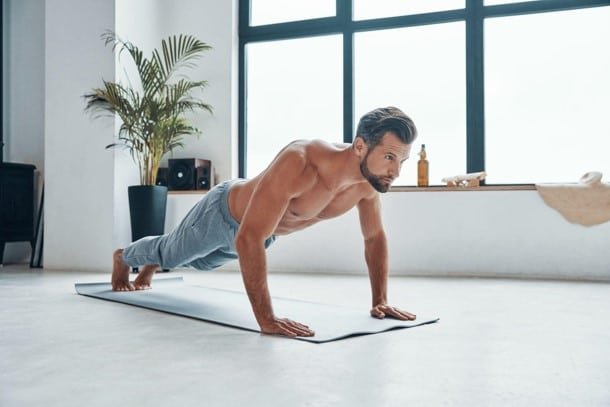
The push-up is the exercise you already know, and it’s on this list because it’s easy to make harder without adding a single thing.
It trains your chest, the front of your shoulders and your triceps, which covers the same muscles as the presses you do at home. The problem is that most guys who lift can knock out 20 or 30 regular push-ups, and when a set runs that long, it takes a lot of reps just to get to the part that’s hard. So instead of one push-up, think of it as a ladder of push-ups that get harder as you climb.
- The easiest version puts your hands on the desk or the edge of the bed.
- The next step up is a regular push-up on the floor.
- After that, do a regular push-up but take 3 seconds to lower yourself, and pause for 1 second with your chest just off the floor.
- The hardest version puts your feet up on the bed, with the same slow lowering and pause.
Find the version where 10 to 15 reps leaves you with 1 or 2 clean reps left. That’s your push-up for this trip.
Here’s how to do a push-up right, whichever version you’re on.
- Set your hands a little wider than your shoulders, with your fingers pointing forward.
- Squeeze your glutes and brace your stomach, so your body makes a straight line from your head to your heels.
- Lower yourself until your chest is just off the floor, keeping your elbows at about 45 degrees from your body instead of flaring them straight out to the sides.
- Push back up until your arms are straight, and that’s one rep.
The mistake to watch for is letting your hips sag toward the floor on the last few reps. Once that happens, your lower back is taking the strain your chest is supposed to be doing, so end the set there, or drop down one step on the ladder.
Sets and reps: Do 2 to 3 sets of 10 to 15 reps, stop each set with 1 or 2 clean reps left, and rest about 60 seconds between sets.
2. Pike push-up
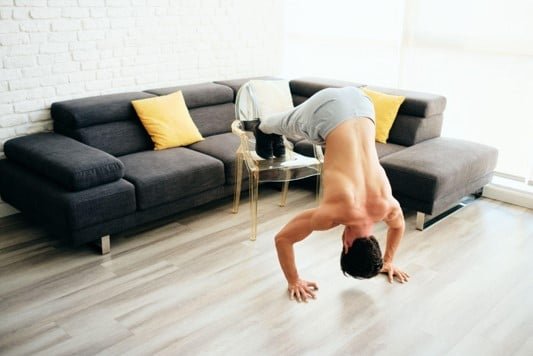
The pike push-up is the closest thing to a shoulder press you can do without weights.
When you push your hips up into the air, your body makes an upside-down V, and your arms end up pressing overhead instead of in front of you. That moves most of the work from your chest to your shoulders, which gives your shoulders something they don’t get from a regular push-up.
Here’s how to set it up step by step.
- Start in a push-up position, then walk your feet in toward your hands and push your hips up until your body makes an upside-down V.
- Set your hands about shoulder width apart.
- Bend your elbows and lower the top of your head toward the floor, aiming for a spot a few inches in front of your hands, so your head and your hands make a triangle.
- Press back up until your arms are straight.
Once that gets easy, put your feet up on a sturdy chair or bed. That tips more of your weight onto your hands and makes every rep heavier, and it’s about as close to a handstand as most guys want to get in a hotel room.
The most common mistake is letting your hips drift down as the set gets hard, which slowly turns the pike push-up back into a regular push-up. Keep your hips high, and if you can’t, end the set.
Sets and reps: Do 2 to 3 sets of 8 to 12 reps, stop each set with 1 or 2 clean reps left, and rest about 60 seconds between sets.
3. Split squat with your back foot on the bed
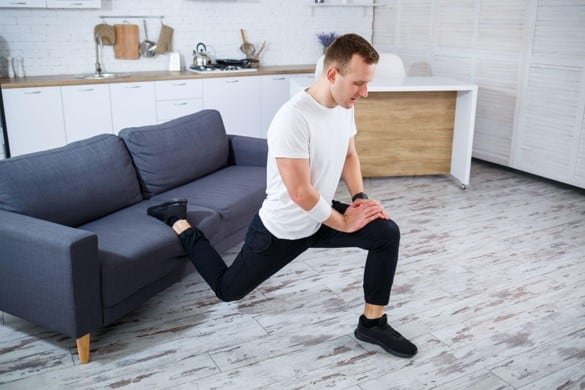
Of the 6 exercises, this is the most important one, because it fixes the biggest problem with hotel room workouts.
You already felt that problem in the test earlier in this post. Regular squats are too easy because both legs share your bodyweight. The split squat puts most of your weight on one leg, which makes it a lot heavier for that leg without you packing a single dumbbell.
Here’s how to set it up step by step.
- Stand about one big step in front of the bed, facing away from it.
- Reach one foot back and rest the top of it on the edge of the mattress.
- Bend your front knee and lower yourself slowly, taking about 3 seconds, until your front thigh is about parallel to the floor.
- Push through your front heel to stand back up, and that’s one rep.
Do all your reps on one leg, then switch. If the mattress is so soft that your back foot sinks into it, use a chair that doesn’t roll instead. And once 15 reps gets easy, put on your backpack.
The mistake to watch for is letting your back leg do the work. Your back foot is only there for balance, so if you feel it pressing down into the mattress, shift your weight forward onto your front leg.
Sets and reps: Do 2 to 3 sets of 10 to 15 reps on each leg, stop each set with 1 or 2 clean reps left, and rest about 60 seconds between sets.
4. Single-leg Romanian deadlift
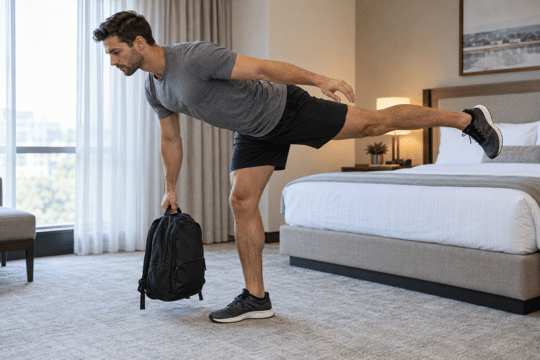
The split squat trains the front of your legs, and the single-leg Romanian deadlift trains the back of them, your hamstrings and your glutes.
At home, you’d train those muscles with a barbell or a pair of dumbbells. On the road, standing on one leg does the same job, because putting all the work on one leg makes it a lot heavier for that leg. It also makes your hips and ankles work to keep you balanced, which is something a lot of guys skip at home.
Here’s how to do it.
- Stand on your right leg with a slight bend in your knee, holding your backpack in your left hand.
- Push your hips back and let your body tip forward, while your left leg rises straight out behind you. Keep your back flat, so your body and your back leg move together like a seesaw.
- Lower the backpack slowly until you feel a strong stretch in the back of your right leg, which for most guys is somewhere around shin height.
- Drive your hips forward to stand back up, and that’s one rep.
Do all your reps on one side, then switch. If you’re wobbling so much that you can’t feel your hamstring working, rest a fingertip on the wall for balance. That doesn’t make the exercise any easier for your leg. It just keeps you from tipping over.
The mistake most guys make is reaching for the floor. If you round your back to get the backpack lower, the stretch moves out of your hamstring and into your lower back. Stop where the stretch is, even if that’s well above the floor. The other thing to watch is your hips. Keep both of them pointed at the floor, because if the hip of your back leg rolls open toward the ceiling, your body twists and you lose part of the stretch in your hamstring.
Sets and reps: Do 2 to 3 sets of 10 to 12 reps on each leg, stop each set with 1 or 2 clean reps left, and rest about 60 seconds between sets.
5. Band row
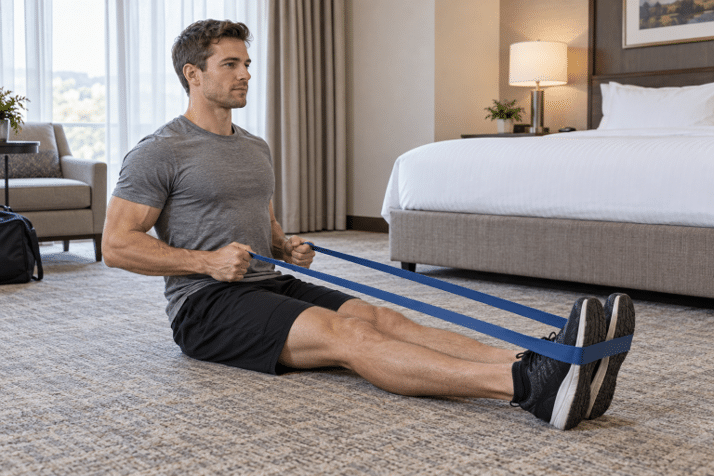
Pulling is the one thing a hotel room can’t give you, and it’s the reason I’d pack a resistance band.
Every other exercise in this post either pushes or uses your legs. Your back and the rear of your shoulders need something to pull against, and a hotel room doesn’t have a pull-up bar or a cable machine. You’ll see people online doing rows hanging under the hotel desk, but a hotel desk wasn’t built to hold your bodyweight. A long loop band weighs almost nothing, fits in the corner of your suitcase, and solves the problem.
Here’s how to do a seated band row.
- Sit on the floor with your legs straight out in front of you and loop the band around the soles of your feet.
- Hold one side of the band in each hand, sit up tall, and lean back just enough that the band is tight with your arms straight.
- Pull your elbows back past your sides, squeezing your shoulder blades together, until your hands reach your stomach.
- Let your arms straighten again slowly, taking about 3 seconds.
If you didn’t pack a band, the backpack works here too. Put one hand and one knee on the edge of the bed, hold the backpack in your other hand, and pull it up toward your hip.
The most common mistake is leaning back to finish the rep. If your upper body rocks back as you pull, the band is too heavy and your back isn’t doing the work. Hold the band a little farther from your feet so it has more slack, which makes it lighter, and keep your upper body still.
And if you have a minute left at the end of the workout, add 1 or 2 sets of band pull-aparts. Hold the band in front of you at shoulder height with your arms straight, and pull it apart until it touches your chest. They train the rear of your shoulders, which is the part that keeps them looking round from the side.
Sets and reps: Do 2 to 3 sets of 12 to 15 reps, stop each set with 1 or 2 clean reps left, and rest about 60 seconds between sets.
6. Plank, done the hard way
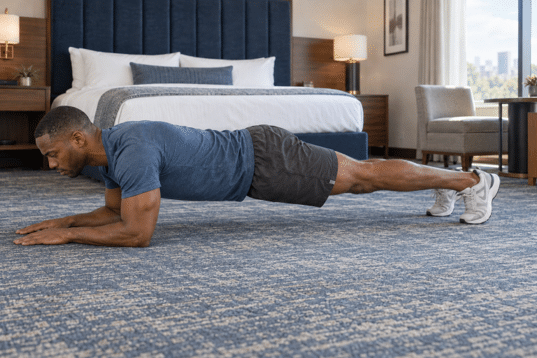
Most guys can hold a regular plank for a minute or more, and holding it for 3 minutes trains your patience more than your abs. So instead of holding it longer, you’re going to hold it harder.
Here’s how to do it.
- Set up on your forearms and toes with your elbows under your shoulders and your body in a straight line.
- Squeeze your glutes and your stomach as hard as you can at the same time.
- Without actually moving them, pull your elbows toward your toes. Your body should start shaking within a few seconds, which is how you know it’s working.
- Hold that for 20 to 30 seconds while you keep breathing.
If you can hold it for more than 30 seconds, you’re probably not squeezing hard enough.
Keep an eye on your hips the whole time. Letting them sag or pushing them up toward the ceiling takes the pressure off your stomach, so keep the straight line from your head to your heels for the whole hold.
Sets and reps: Do 2 to 3 holds of 20 to 30 seconds, and rest about 60 seconds between holds.
How to put these together
You don’t need all 6 exercises every time you work out, but here’s how to fit them into one workout when you have the time.
The 25-minute workout runs the 6 exercises in 3 pairs. Do one set of the first exercise in the pair, rest about a minute, do one set of the second exercise, rest about a minute, and repeat until you’ve done 2 or 3 rounds. Then move on to the next pair.
- Pair 1: Split squat and push-up
- Pair 2: Single-leg Romanian deadlift and band row
- Pair 3: Pike push-up and plank
Each pair puts a lower-body exercise next to an upper-body one, or a hard exercise next to a lighter one, so one set of muscles rests while the other works. With 2 rounds of each pair, the whole workout takes about 25 minutes including your warm-up.
For a packed day, there’s a 10-minute version. Do 2 rounds of the split squat, the push-up and the band row, one after the other with only as much rest as you need. Those 3 cover your legs, your pushing muscles and your pulling muscles, and on a busy trip, that’s enough to count.
Before your first working set, warm up with 1 easy set of the split squat and 1 easy set of the push-up, using a version a step or two down the ladder.
If your hotel gym has dumbbells, use them. Hold a dumbbell in each hand for the split squat and the single-leg Romanian deadlift, and do a one-arm dumbbell row instead of the band row. Everything else about the workout stays the same.
And on every exercise, end each set with 1 or 2 clean reps left in you. Taking every set to failure piles up more fatigue than your body can recover from, and on a trip, you’ve got a long day of walking, meetings or sightseeing after the workout too.
This plan works, but it isn’t the only way to train on the road. If you’d rather do fewer exercises with more sets, or swap in something that feels better on your joints, go ahead, as long as every set is hard and you’re training your legs, your pushing muscles and your pulling muscles each week. And when you get home, if you’d rather have your whole week planned out for you, my book Lean Into Muscle has 3 ready-to-use workout templates, for 3, 4 and 5 training days a week.
How to keep it hard on a longer trip
On a short trip, you don’t need to make progress. You only need every set to stay hard enough to count, and that’s what the push-up ladder and the 3 tricks are for.
On a longer trip, the exercises are going to get easier as the weeks go by, and you’ll need a way to keep adding to them. At home, you’d add weight. In a hotel room, you add difficulty instead. Once you can do the top of the rep range with 2 clean reps still left, make the exercise harder in this order:
- Slow the lowering down to 3 seconds if you haven’t already.
- Add a 1-second pause at the bottom of each rep.
- Add the backpack, or put more in it.
- Move to the next version up, like going from push-ups on the floor to push-ups with your feet on the bed.
Each step takes your reps back down to the bottom of the range, and you build back up from there. It’s the same idea as progressive overload at home, just without the dumbbell rack. There’s a longer explanation of how that works in the progressive overload guide.
Quick tips for staying fit on the road
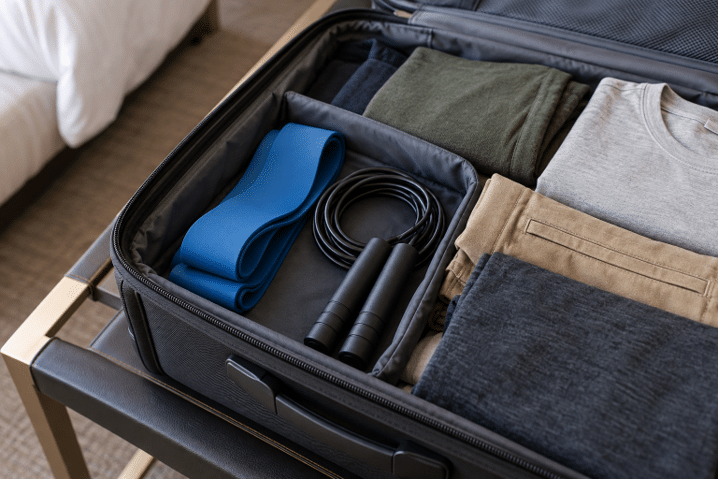
The workout above covers the days when it’s just you and a hotel room. But most trips give you more options than that, and here are 4 ways to take advantage of them.
- Check out the hotel gym, even if it’s tiny. A lot of hotel gyms are a treadmill, a bench and a rack of dumbbells that stops well short of what you lift at home. That’s still enough to get the job done. Remember, on the road you’re trying to keep your muscle, not build it, so light dumbbells work fine as long as you use the same tricks from this post: one arm or one leg at a time, 3 slow seconds on the way down, and a pause at the bottom.
- Get a day pass at a local gym. If you want real weights, look up a gym near where you’re staying. A lot of the big chains give first-time visitors a free day or a free trial pass, and when you do have to pay, a day pass usually runs somewhere around $10 to $25. Check the gym’s website or call ahead, because the rules change from one location to the next.
- Count your steps. Whether you’re exploring a new city on vacation or walking to meetings on a work trip, track your steps on your phone, because every step is part of the workout. The average American takes about 5,000 steps a day, and a full day of sightseeing on foot can easily put you at 3 or 4 times that without you even trying. Your phone counts them for you, so all you have to do is check the number at the end of the day.
- Pack a jump rope and a resistance band. Both fit in the corner of your suitcase and weigh almost nothing. The band is what makes the rows and pull-aparts from earlier in this post possible, and the jump rope gives you a quick cardio session.
Eating on the road
If your goal is to come home lean, what you eat on the trip matters more than any hotel room workout. You don’t need a perfect week, just a good enough one, and 3 habits will get you most of the way there.
First, build every meal around protein. Protein is what helps your muscles hold on while your training is lighter than usual, and it also keeps you full, which makes it a lot easier to say no to the bread basket. At a restaurant, that can be as simple as ordering a steak, a piece of fish or a double order of chicken on whatever you’re getting.
Second, pack your own backup. At most airports, a cinnamon roll is easier to find than a chicken breast, and a delayed flight can leave you stuck there with nothing but the food court. A protein bar, a bag of almonds and a scoop of protein powder in a zip-top bag take up almost no room in your carry-on, and they give you something better to eat than whatever’s closest to the gate.
And third, count your drinks. You’re allowed to enjoy a vacation, and nobody’s telling you to skip the beer on the beach. But drinks add up fast, so decide ahead of time how many you’re going to have and enjoy those, instead of losing count by the third night.
Most of all, don’t let one big dinner turn into a lost week. One meal doesn’t undo anything, and the next meal is your chance to get back on track. If you want the full picture of how to eat to get lean, the guide on how to build muscle and lose fat at the same time walks through it.
Common questions
Should I just take the week off? That’s your call, and either choice is fine. If you’ve been training hard for months, a week off won’t cost you anything you can’t get back, and a lot of guys come back feeling better for it. But if you like training or the trip is longer than a week, the 25-minute workout once or twice a week keeps you in the habit and keeps your sets hard.
My hotel doesn’t have a gym. Should I just skip it? No, you don’t need one. Every exercise in this post uses your bodyweight, a bed and a backpack, so a hotel without a gym still has everything the workout calls for.
I’m over 60. Do I need to do more? You probably do, a little. The research on older lifters suggests that holding on to muscle takes about 2 workouts a week with 2 to 3 sets per exercise, so plan on the 25-minute workout twice a week instead of once.
Do I need to do cardio on the road? Not if you’re walking a lot, and on most trips you will be. If your days are mostly spent in meetings or on a plane, 10 minutes with the jump rope or a long walk after dinner covers it.
Where to start
One of my personal mantras is that push-ups and walking are free. Again, all you really need is you. So before your next trip, run the split squat test at home, find the push-up version that leaves you 1 or 2 reps to spare somewhere between 10 and 15, and put a band in your bag. When you get to the hotel, you’ll already know your workout, and the only decision left is when you’re going to do it.
Readers Also Read