Fall Fashion Essentials for Men: The 6 Things Worth Owning
Walk through any city around 2 in the afternoon on an October day and count all the jackets nobody is wearing. You’ll see them slung over a shoulder, hooked on a finger, folded across a forearm, or stuffed into a bag with the sleeves hanging out. That morning, Alexa said it was a little nippy outside, so everybody dressed for the 8 a.m. weather. By two in the afternoon, they’re carrying those coats or sweating through a chunky sweater.
That’s not poor planning. That’s just tricky old fall weather for you.
And I’m not knocking those guys. I’ve been one of them plenty of times. Taking a layer off at some point in the day is just part of fall, and there’s no getting around it.
Fall is the tough season for getting dressed because it has a specific temperature range that goes from warm to chilly, which means you can’t settle for one outfit all day. Some might find that a little frustrating, but that’s exactly why I love fall.
2-MINIUTE CONFIDENCE QUIZ
Find out what's holding you back: your body, your style, or your dating life.
9 questions. You get a score for each and the one area to work on first.
You can start with a shirt, add a sweater on top, and then throw a jacket over it. And in this full ensemble, you are a completely different human being than the one who was in that flimsy T-shirt at the beginning. Fall allows you to become a creative director with almost limitless options. That doesn’t and can’t happen in July.
So the question is: how do you pull off the fall look that keeps you fashionable and polished without freezing, sweating your butt off, or carrying a bulky coat all afternoon?
That’s why we are here. Let’s dive into the 6 things worth owning, what each one actually does for you, and what you should expect to pay.
Cheat code before you start
If you don’t want to buy all six: Start with the overshirt. It’s the one piece on this list that can replace a jacket on a cool morning and still stay on when the day warms up. If you’ve got room in the budget for two, add the thin merino sweater. For three, add the lightweight jacket. Those three give you the most options as the temperature moves around.
1. Collared shirt you'd wear on its own

You already own shirts, so this is probably the most obvious-sounding thing on the list. And if the words collared shirt make you picture the thing you wear to a wedding, or to an office you don’t work at anymore, I understand why you would be tempted to scroll past this.
But stay with me for a second, because this one earns its spot. An Oxford cloth button-down is not a dress shirt. It’s a casual shirt that happens to have a collar, and that collar is what lets you take a sweater or a jacket off in the middle of the day and still look like a man who got dressed on purpose. And it does that job better than anything else in your closet.
So here’s what an Oxford actually is, in case you’ve been living on another planet and never bought one. It’s made from basketweave cotton, so the fabric has a little visible texture instead of being flat and shiny like a dress shirt. It comes in white, light blue, and a dozen other colors, and it goes with jeans, chinos, and almost everything else you already own. One thing to know going in: Oxford cloth wrinkles more than most shirts do. Some of that is the point, because an Oxford is supposed to look a little lived in, but if you like looking pressed, you’ll be reaching for the iron.
Styling tip: Four things separate an Oxford you’ll wear constantly from one that hangs in the closet.
- You can wear the same shirt four ways in a single day without changing clothes. Button it up under a sweater in the morning, take the sweater off at lunch and now the shirt is the whole outfit, roll the sleeves when the afternoon warms up, and let it hang open over a T-shirt on the walk home.
- Get the button-down collar specifically. Those two little buttons hold the collar points flat when you pull a sweater off over your head, which is the moment a normal collar ends up twisted under your chin. A spread or point collar on a casual shirt also looks like you forgot to put a tie on.
- Look at the collar before you buy. You want some roll in it, meaning a gentle arc between the button and the point instead of a dead flat line. That curve is a lot of why an expensive Oxford looks expensive. It’s also the first thing to go on a cheap one, because after a handful of washes the stiffening inside starts to bubble and go shiny, and nothing fixes that.
- Buy light blue before white. White is what most men reach for first, but light blue works harder with denim, sits better under a sweater, and doesn’t show wear as fast.
Where to find a good price and quality: Lands’ End and J.Crew Factory both keep Oxfords between $40 and $60, and that’s the range where you get one you’ll still wear in three years.
2. The subtle thin knit that makes an impression

Just like the shirts, you already own a sweater or two. But the reason this one is on the list is very specific.
Most of the sweaters men own tend to be on the thicker side, and it’s tough to layer anything over a thick sweater. Once it’s on and you try to put a jacket over the top of it, you start moving like a robot, and you look a little bulky. A thin knit goes over your shirt and under your jacket without any of that. That means you can wear all three pieces when you leave the house at 8 in the morning, and then take them off one at a time as the day warms up.
Here’s what to look for when you are shopping for knits. Get merino wool or lambswool, and it should be thin enough that you can still see the shape of your own shoulders through it. Hold it up to a window before you buy it, and if you can almost see the light coming through, that’s the right one. Wool is worth paying for over cotton for two reasons. A thin merino sweater can give you plenty of warmth without the bulk of a heavy cotton sweatshirt, and if you get caught in a light rain, wool still does a much better job of keeping you warm when damp.
Styling tip: Three things to get right with this one.
- Let a little of the shirt do the work. Keep the collar points tucked neatly inside the sweater’s neckline, and let about half an inch of cuff show at your wrists. You still get the contrast of the collared shirt without having the collar fighting with the sweater around your neck. That’s the whole look, and it’s one of the reasons the collared shirt is number one on this list.
- Start with navy, grey, or oatmeal. All three go over any shirt you own and under any jacket you own, which is the point of the piece. Save the bright one for when you already have a plain one.
- It’s delicate, so know that going in. Thin merino snags on watches, belt buckles, and the corner of a desk, and once a thread pulls, it doesn’t go back in. It also wants a cold wash and needs to dry flat. That takes about 10 seconds of attention, and skipping it can ruin the sweater.
Where to find a good price and quality: Uniqlo’s Extra Fine Merino is the one everybody in menswear points at, and it’s the cheapest real merino most guys can walk into a store and buy for $40. Read the tag on anything cheaper, because plenty of sweaters say merino on the front and 10 percent wool on the inside.
3. Overshirt

There’s a good chance you don’t own an overshirt, and there’s an even better chance you’ve looked at one and thought, why would I want a thick shirt? If it’s cold enough that I need another layer, why wouldn’t I just put on a jacket?
That’s a fair question, and here’s the answer. A jacket is one thing or the other. Either it’s on, and you’re warm, or it’s off, and you’re carrying it around all afternoon. An overshirt does both jobs at once: it’s warm enough to be your jacket when it’s 51 degrees in the morning, and light enough to keep on when you walk into a restaurant at 65. That’s why it’s on this list, and it’s why I’d tell you to buy this one before you buy anything else on the page.
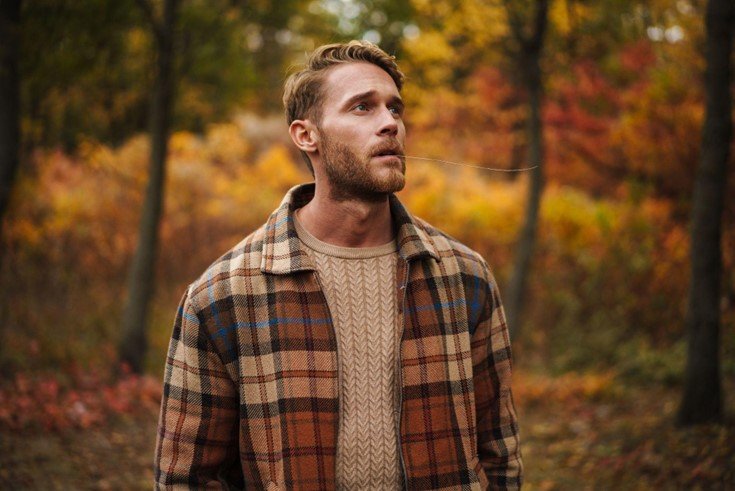
Before we get into why it works, here’s what an overshirt actually is. It’s a shirt that’s made out of jacket cloth. It might be flannel, or canvas, or moleskin, or wool, and what matters is that the cloth has some real weight to it. It has a collar, and it has buttons down the front the same way a shirt does, but it’s thick enough that you wear it over your clothes instead of tucking it into anything. You’ll see it sold as a shirt jacket, or as a shacket, or under two or three other names depending on who’s doing the selling, and all of them are the same thing.
Styling tip: This one does more for how you look than anything else on the list, so here’s how to get that out of it.
- There’s a thing in menswear called the third piece rule. A shirt and a pair of pants are two pieces, and two pieces can read as plain depending on the combination. Put a third layer over the top and the same outfit suddenly looks like you’re a man with a plan.
- Wear it open. That puts two long vertical lines down your front, and vertical lines make a man look taller and leaner. It’s the same reason an open cardigan does something for you and a buttoned one doesn’t.
- Check the cloth before you pay, because a lot of what gets sold as an overshirt is really just a loose flannel shirt with a nicer name on the tag, and you won’t find that out until you’re standing on a corner in the wind wondering why you’re cold. Pick it up and hold it out in front of you by the shoulders. A real overshirt holds its shape and stands up on its own. If it flops over your hand the way a dress shirt does, then it’s a shirt, and it goes back on the rack.
Where to find a good price and quality: H&M has a whole wall of them between $40 and $60, and Target’s Goodfellow line sits right around there too.
4. Lightweight jacket you can carry
On any given fall morning, every man walks out of his house in one of three camps.
The first guy says, “Forget it, I’ll be a little chilly for a while, and he heads out in just a shirt, or a shirt and a sweater”. He’s a little cold until about ten in the morning. But by two in the afternoon he’s perfectly comfortable, and he’s got nothing in his hands.
The second guy looks at 51 degrees on his phone and breaks out the winter coat. He’s warm at eight in the morning, and he’s sweating through his shirt by eleven. And now he’s hauling that big coat around with him for the rest of the day.
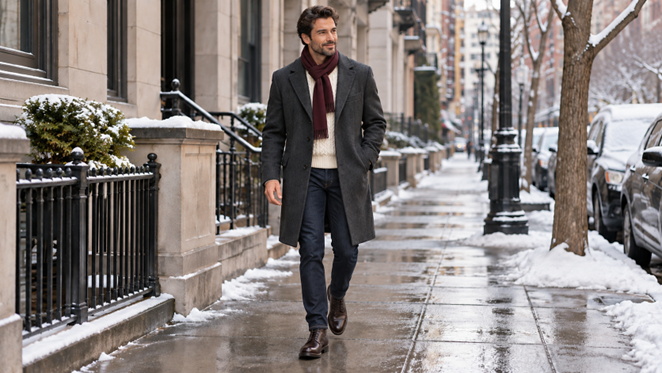
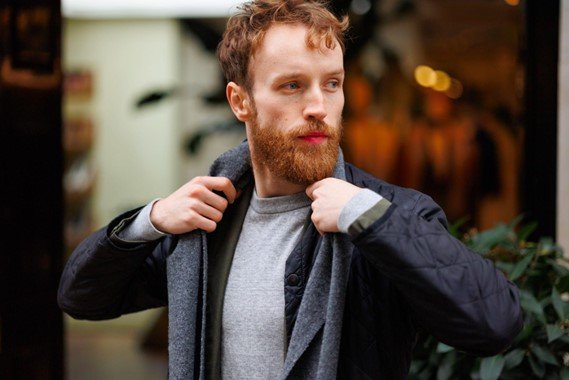
The third guy has a light jacket on, and he’s the one who looks the best from the time he leaves until the time he gets home. He’s warm on the walk in. He takes the jacket off when the afternoon warms up, and it folds flat over his arm and stops being a problem. That’s the camp you want to be in, and this is the piece that gets you there.
What kind of jacket? A chore coat, a trucker jacket, a harrington, or a light bomber are all examples of jackets that will do the job. Pick whichever one you like the most, but check the weight before you pay, because the weight is what decides whether you can carry it at two in the afternoon without it turning into an inconvenience. And it’s an easy test. Fold it over your forearm in the store, and if it doesn’t lie flat or it feels like a load, it isn’t the one.
One more thing while you’re in the fitting room. You’re going to wear this over a shirt and a sweater, not over a T-shirt, so try it on that way. A jacket that fits you beautifully over a tee is a jacket you can’t close in November.
Styling tip: Your jacket is your first impression. It’s the first thing anybody sees and the last thing they remember, so three things are worth getting right, and none of them is the price.
- The first is where it ends. A fall jacket should stop at your hip bone or an inch below it. That hem draws a horizontal line across your body, and where the line lands is what makes your legs look long or short. Anything hanging down to mid-thigh cuts you in half.
- The second is the shoulder seam, which should sit right at the edge of your shoulder where your arm starts. If it’s drooping down onto your bicep, the jacket is too big, and no amount of good fabric fixes that.
- On color, olive, navy, tan, and brown all work over everything else on this list. Black is the one to skip if you’re only buying one, because black reads like winter and it fights the brown boots further down the page.
Where to find a good price and quality: Old Navy and Uniqlo both sit between $50 and $90.
5. Pants with some weight to them
Jeans are jeans, right? That’s what most men think, and it’s why nobody ever thinks about their pants in the fall until they’re three hours into the workday and there’s nothing to be done about it.
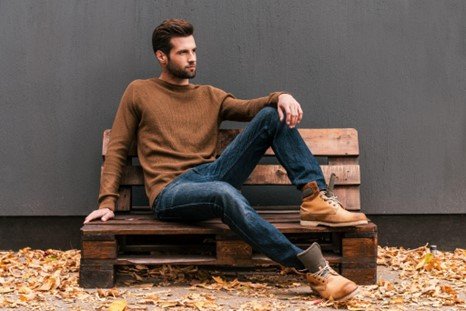
Here’s what most guys don’t know. Pants come in weights, the same way a sweater does, and the pair you wore all summer may not be the pair you want in October. Denim is the easiest place to see it because it’s one of the few fabrics where the weight is often listed. Anything under about 12 ounces is considered lightweight, while 12 to 16 ounces gets into midweight territory. For fall, somewhere around 12 to 14 ounces is a good place to be. It gives you more substance than lightweight summer denim without feeling like you’re breaking in a pair of heavy work jeans. The same basic idea holds for chinos and corduroys. You want something with enough weight to handle a chilly morning but still comfortable enough to sit in all day.
Your pants are also the only thing on this list you can’t take off when you get it wrong, so it’s worth a few minutes of thought before you buy.
Styling tip: Four things separate a pair you’ll actually wear from a pair that sits in your closet.
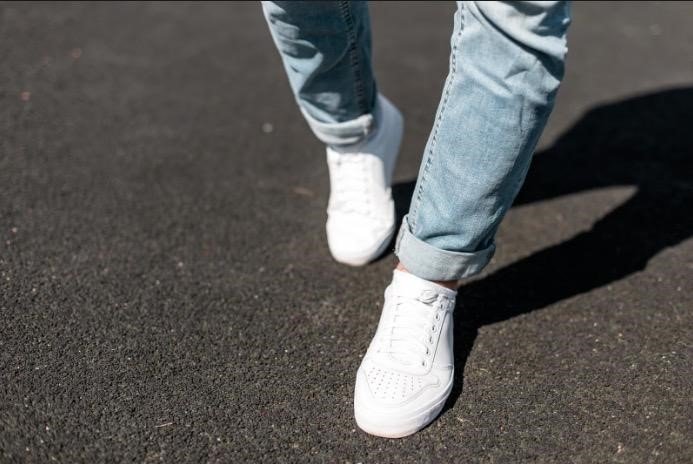
- Where the hem lands is the most common thing men get wrong with pants. It should reach the top of your shoe with one small fold in it and no more than that. Fabric pooling on top of your boot makes your legs look shorter every time.
- Go dark. A dark indigo reads sharper than a light wash and works with everything else on this page, and the same holds for cords, where a brown or an olive or a charcoal beats a pale one every time in the fall.
- Don’t overdo the stretch denim. A little stretch can make jeans more comfortable, but once they start feeling closer to athletic pants than denim, they usually lose the structure that makes a good pair of jeans look sharp. Look for denim that keeps a clean line from your hip down to your shoe instead of clinging to every part of your leg or bagging out at the knees by the afternoon.
- Sit down in them for a full minute in the fitting room. Plenty of jeans look great in the mirror and then dig into your waist by hour three. Raw rigid denim is the worst offender, and while it breaks in beautifully, it’s miserable in a desk chair for the first month.
Three to start with. The first two are jeans, and the third is the one most men forget about.
- Levi’s 501. The default, and it’s the default for a reason. Straight leg, all cotton, no stretch. It’s about $85 on levi.com and cheaper at nearly every store that carries it, so buy it anywhere but there.
- Uniqlo’s selvedge jeans, in the slim straight fit. Made with Kaihara denim, the Japanese mill that supplies a lot of brands charging three and four times as much. Mostly cotton with just a touch of stretch, and it’s the cheapest way to own real selvedge.
- A pair of corduroys. Not jeans, but they do the same job in the fall, and they look a little sharper doing it. Uniqlo and J.Crew both make them, and they cost about what the jeans above do.
6. Shoes that don't mind rain

You’re probably planning to wear the same sneakers you’ve worn all summer, and for a lot of days in October that’s completely fine.
The problem shows up when it rains. Fall brings enough wet days that eventually those summer sneakers stop being the easy answer, and the shoe most men reach for when they finally do change out of them is suede. Untreated suede and rain do not get along, and most guys find that out the expensive way, in one afternoon, on a wet sidewalk.
What you want instead is a brown leather chukka or a plain derby. A chukka is an ankle-high boot with two or three eyelets, while a derby is a low-cut leather shoe with open lacing and a similarly casual feel.
Styling tip: Shoes are where an outfit gets finished, or it doesn’t. You can have the right shirt on and the right jacket over it, and if you’re still in the running sneakers you wear to the gym, the whole thing reads as unfinished.
- Buy brown before you buy black. Brown works with navy, grey, olive, and denim, which covers most of what’s on this page. Black is the harder one to place in the fall, and it’s the second pair you buy, not the first.
- Get it on a rubber sole. A leather sole on a wet sidewalk is genuinely slippery, and it soaks up water and takes two days to dry out.
- If you buy the suede anyway, and most men do because it looks better, pick up a can of protector spray on the same trip and use it before the first wear instead of after the first rain. It’s about $10 and 5 minutes of your evening.
- Leather creases across the toe inside a month, and that crease never comes out. That isn’t a defect; that’s what leather does when you walk in it.
Where to find a good price and quality: The Clarks Bushacre 2 is the one to get. Get the leather version, not the suede. Rubber outsole, and it lists at about $110.
3 fall outfits you can build from these 6 pieces
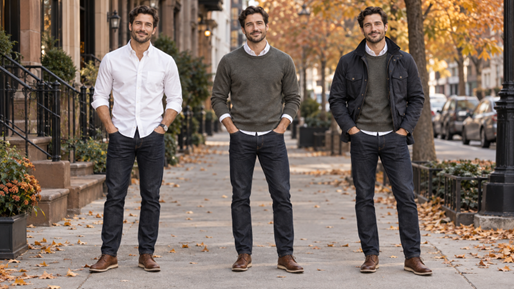
The best part about these six pieces is that you don’t need to wear all of them at once. They work because you can mix them depending on what the weather is doing.
Warmer fall day: Oxford shirt, dark jeans and brown leather shoes. Roll the sleeves when it warms up and you’re done.
Cool fall day: Oxford shirt, thin merino sweater, dark jeans and brown chukkas. You get one extra layer without adding enough bulk to make you regret it by lunch.
Cold fall morning: Oxford shirt, thin merino sweater, lightweight jacket, dark jeans and brown leather shoes. Take the jacket off first, then the sweater if the afternoon warms up.
And if you own an overshirt, it can replace either the sweater or the jacket depending on the temperature. That’s really the point of this entire list. You’re not buying six separate outfits. You’re buying six pieces that can keep rearranging themselves all fall.
Common questions
Isn’t this just layering? It is, except that layering on its own is useless advice, because nobody who says it ever tells you what to layer. A hoodie over a sweatshirt is technically layering, and it’s also two thick things that can’t come off once they’re on. Six thin pieces that work in any combination is the part that nobody bothers to say out loud.
What about fall colors? There’s no such thing, and I’ll die on this one. There is nothing about the month of October that suddenly makes rust and olive correct and pale blue incorrect. Fall clothes tend to show up in deeper, earthier colors because that’s how brands design and merchandise the season, and heavier fabrics like wool, corduroy, and waxed cotton naturally look at home in them. But that doesn’t mean you have to dress like a pile of leaves. If pale blue looked good on you in June, it can still look good on you in October. Just wear it in a fabric that makes sense for the weather.
Can I just wear a hoodie? Of course you can. A hoodie over a T-shirt is most of America on a Saturday, and there’s nothing wrong with it. The only thing a hoodie won’t do is fit underneath a jacket without bunching up at your shoulders and fighting your collar, and that’s the one job the thin knit does better. So wear the hoodie on the days when the hoodie is your outside layer.
Do I need a fall jacket and a winter coat? You do, and this is the one place where fall actually costs you money, so I’m not going to talk around it. They’re two different tools. A winter coat at 60 degrees is unwearable by 11 in the morning, and a fall jacket in February is decoration.
What do I do about the mornings? You’re going to be a little bit cold for 20 minutes, and that’s the real answer, and I know it isn’t the one you were hoping for. Everybody out here dressing for the coldest 20 minutes of their day is exactly why the whole city is carrying a jacket by lunch.
Where to start
Go stand in front of your closet and ask yourself one question. What would you put on for a 60-degree day?
Most men own summer clothes, and they own winter clothes, and there’s a hole in the middle where fall is supposed to be. If your honest answer to that question is a T-shirt and you’d be cold, or your winter coat and you’d be cooking by 11 in the morning, then you’ve found the hole.
Now go back through the six. You’ve almost certainly got some version of a couple of them sitting in there already, and the ones you’re missing are the ones to buy. You don’t need all six this month, and you don’t need to drop $600 in an afternoon. Buy one, wear it through a week of October, and then go get the next one.
Prices above are regular retail at the time of writing, and they move around, so treat them as a ballpark and not a quote. No affiliate links, no sponsored placements, and nobody paid to be on this page.
Readers Also Read