

Skip the Testosterone Boosters: 5 Natural Fixes That Actually Work

Scroll through TikTok or Instagram for a few minutes and there’s a good chance you’ll find a guy telling you your testosterone is low. If you’re tired, stressed, or not as interested in sex as you used to be, he’s sure that’s the reason, and he usually has something to sell you to fix it. Sometimes it’s a supplement, sometimes it’s a morning routine with an ice bath and a plate of liver, and sometimes it’s an online clinic that will ship a prescription to your door.
When a team of public health researchers went through the most popular of those posts, about two-thirds of them linked to something you could buy or a consultation you could book, and almost a third of the influencers behind them said they were doctors. And a lot of what they’re selling ends up going to men whose testosterone is already in the normal range.
What most of those posts leave out is that 5 everyday things have a real effect on your testosterone: the size of your waist, how much you sleep, how much you eat, how much you drink, and whether you lift. You can check all 5 yourself in about 5 minutes, and fixing the ones you fail doesn’t cost anything. So before anybody sells you anything, this guide is going to walk you through those 5 checks.
Before we get to the check, we’ll cover what testosterone actually does for you, because it isn’t quite what those posts say. After the check, we’ll cover what to do if you pass all 5 and still feel off, and what the research says about the testosterone boosters those posts are selling.
What testosterone does for you, and what it doesn't
Testosterone affects a lot more than how you look. It plays a big part in your energy, your sex drive and your mood, and it helps you hold onto muscle and keep body fat down. When it runs low, most guys notice it as being tired all the time, losing interest in sex, or just feeling flat.
But a higher testosterone level doesn’t automatically mean more muscle. Researchers at McMaster University in Canada, led by Robert Morton, put 49 men who already lifted through 12 weeks of training and measured how much each man’s hormones rose after his workouts. The men with the biggest testosterone spikes didn’t build any more muscle or strength than the men with the smallest. When the team went back through their data, what lined up with muscle growth was how many androgen receptors each man had in the muscle itself. Those receptors are the part of the muscle that responds to testosterone, and there’s no known way to raise them on purpose.
So if your testosterone is in the normal range, you’re not chasing a bigger number to grow in the gym. The goal is to make sure nothing in your life is dragging your testosterone below where it should be.
Average testosterone in young American men has also come down. National health survey data on men between 15 and 39 showed it dropping from 1999 to 2016, and the heavier the men were, the lower it tended to be. The drop showed up in men at a normal weight too, so weight isn’t the whole explanation, but it’s a big part of it, and it’s a part you can change.
How the 5-minute check works
Each of the 5 tests below is a clear pass or fail. If you pass, move on to the next one. If you fail, that’s the one to work on. They’re in order from the one that tends to matter most to the one that tends to matter least.
Here’s what you’ll need: a tape measure, a rough idea of when you fell asleep and woke up each night last week, which your phone or watch may already track, and an honest count of every drink you had in the last 7 days, including the weekend. The other 2 tests are questions you can answer from memory.
Depending on your situation, some of these won’t apply to you at all. If you’re already lean, you’ll pass the waist test in about 10 seconds. If you rarely drink, you’ve passed the drinking test before you start.
1. Measure your waist
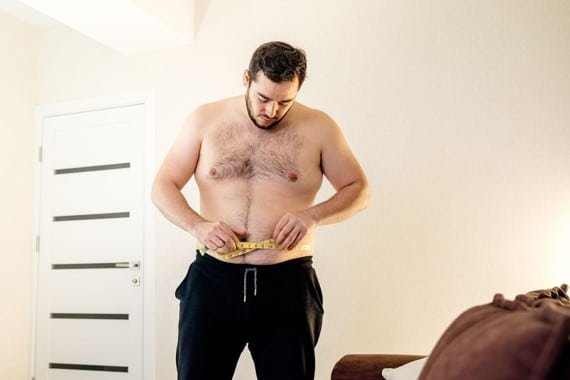
Most guys only measure their waist when they’re buying pants, and when the jeans get tight, they go up a size and don’t think about it again. But your waist size is more closely tied to your testosterone than anything else on this list, which is why it’s first.
Here’s exactly how to measure it. Stand up straight, relax your stomach, and wrap the tape measure around your waist at your belly button. Don’t suck in. Nobody else is going to see the number, so the only person you’d be fooling is yourself.
If your waist is under about 37 inches, this one probably isn’t your problem. If it’s over 40, it’s very likely the first thing you should fix, and if you’re somewhere in between, it’s still worth working on. Those numbers come from a large study of men seen at a primary care clinic. Fewer than 1 in 10 of the men with waists under about 36 and a half inches had low testosterone, and at 43 inches and up, it was almost half.
The good news is that your testosterone moves with your waist in both directions. When you lose weight, it goes up, and when you gain weight, it goes down. Researchers in Italy pooled the weight-loss studies and found that men who dieted off about 10 percent of their body weight saw their testosterone rise by about 84 ng/dL on average. To put that in perspective, the line doctors use for low testosterone is 300 ng/dL.
If your waist is over about 37 inches, bringing it down takes 2 things. First, put yourself in a small calorie deficit by eating about 20 percent below your maintenance calories, which for most guys works out to losing about a pound a week. And second, keep lifting and keep your protein at about 1 gram per pound of body weight, so the weight you lose comes off as fat and not muscle. We go through how to set that up step by step in our guide on how to build muscle and lose fat at the same time.
For example, say you weigh 210 pounds and your waist is 41 inches. At about a pound a week, you’d be down around 20 pounds in about 5 months. That’s roughly 10 percent of your body weight, which is right about where the diet studies saw that rise in testosterone, and you should see your waist come down along with it. Keep the tape measure and check it once a week, because the scale only tells you that you weigh less, and the tape tells you that what you lost was fat.
The most common mistake here is trying to drop the weight as fast as possible. Eating very little brings your testosterone down on its own, which we’ll get to in the eating section, so a crash diet ends up fixing one problem by creating another.
2. Count your sleep

You’ve heard “get more sleep” so many times that it probably sounds like something your mom would tell you. But sleep is the one thing on this list where a single week can make a real difference to your testosterone, so it’s worth the minute it takes to check.
For this test, figure out about how many hours you actually slept each night over the last 7 nights, including the weekend, and take the average. If your phone or watch tracks sleep, use that. If not, a rough count of when you fell asleep and when your alarm went off is close enough. You pass if you’re averaging at least 7 hours, which is the minimum sleep experts recommend for adults.
Sleep is on this list because most of the testosterone your body makes in a day gets made while you’re asleep, so when you cut your sleep short, you also cut into the time your body uses to make it. In a University of Chicago study run by Rachel Leproult and Eve Van Cauter, healthy men in their mid-20s slept 5 hours a night for one week, and by the end of that week, their daytime testosterone had dropped 10 to 15 percent. That’s about the drop you’d expect from 10 to 15 years of aging.
Short sleep also makes it harder to get your waist down. In a second University of Chicago study, people on the same diet lost about the same amount of weight whether they slept 8 and a half hours or 5 and a half, but the short sleepers lost much less of it as fat and much more of it as muscle.
If you came in under 7, here’s how to fix it.
- Pick a bedtime that gives you at least 7 and a half hours before your alarm, and keep it on the weekends too.
- Stop drinking caffeine by early afternoon. About half the caffeine from a coffee is still in your system 5 or 6 hours later, so a coffee at 4 p.m. is still working when you’re trying to fall asleep.
- Keep your bedroom dark and cool.
- Put your phone somewhere you can’t scroll it from bed.
To put real numbers on the bedtime, say your alarm goes off at 6:30 on weekdays, but you’re usually scrolling in bed until after midnight. That’s about 6 hours a night, 5 nights a week, and then on Saturday you sleep until 10 and figure you caught up. But you’re still short on 5 nights out of 7, and those weeknights are the ones to fix. If you work back 7 and a half hours from 6:30, your bedtime is 11, and you keep that bedtime on Saturday too.
The mistake to watch for is believing you’ve adapted. Plenty of guys running on 5 or 6 hours a night say they feel fine, and usually what’s happened is that they’ve been tired for so long that tired feels normal.
3. Check how you're eating

The eating test is the one that catches guys who are doing everything else right. If you’re working on your waist, you’re watching what you eat, and the harder you diet, the more likely you are to fail this one.
This test is 2 questions. First, if you’re trying to lose weight, are you eating more than about 20 percent below your maintenance calories, or losing more than about 2 pounds a week? If you don’t know your maintenance calories, an online TDEE calculator will estimate them from your age, height, weight and activity level in about a minute. And second, are you getting at least 0.3 grams of fat per pound of body weight a day? For a 200-pound guy, that’s 60 grams, which is roughly what you’d get from 3 eggs, a salmon fillet, a handful of almonds and a tablespoon of olive oil spread across the day. If you answered yes to the first question or no to the second, this is a test to work on.
Eating is on the list for 2 reasons. First, cutting the fat in your diet too low lowers your testosterone. And second, eating too little overall does the same thing, because when your body is short on food for weeks at a time, it cuts back on making testosterone.
When the same men were put on a low-fat diet and then a higher-fat diet, their testosterone came in 10 to 15 percent lower on the low-fat one, though it stayed in the normal range. The low-fat diets got about 20 percent of their calories from fat, and the higher-fat diets got about 40 percent. Those were only 6 small studies, but they all pointed the same way.
Bodybuilders getting ready for a competition are the extreme example of eating too little. Researchers tracked one drug-free bodybuilder through 6 months of contest prep, and as his body fat went from about 15 percent to under 5, his testosterone fell by roughly 75 percent. It came back to normal after the show, once he was eating normally again. You’re probably not dieting anywhere near that hard, but it shows what happens to your testosterone when you cut calories too far for too long.
The fix depends on which question you failed. If it was the first one, bring your deficit back to about 20 percent below maintenance instead of slashing everything at once. When guys cut hard, fat is usually one of the first things to go, and they end up low on calories and low on fat at the same time. If it was the second one, get your fat from real food at most meals, like eggs, red meat, salmon, olive oil, nuts and avocado. And if you need to cut more calories later, take them from carbs and leave your protein and fat where they are.
Going to the other extreme is a mistake too. Eating more and more fat doesn’t keep raising your testosterone, and every gram of fat has 9 calories, more than twice as many as a gram of protein or carbs. So pouring olive oil on everything is an easy way to wipe out the calorie deficit you set up to bring your waist down.
4. Count your drinks

You probably couldn’t say exactly how many drinks you had last week. It isn’t a number most people keep track of, and a beer with dinner and a few on Saturday never feel like they add up to much.
So for this one, count every drink you had in the last 7 days, and be honest about the weekend. One drink is a 12-ounce beer, a 5-ounce glass of wine or a 1.5-ounce shot. The CDC considers 15 or more drinks a week heavy drinking for men, and it considers 5 or more drinks on one occasion a binge. If you’re over either line, you failed this one.
Alcohol is fourth on the list because for most guys it only matters if they drink a lot. A drink or 2 with dinner doesn’t appear to do much to testosterone over the long run, but heavy drinking does. Over time, heavy drinking damages your body’s ability to make testosterone, and alcohol also makes your sleep worse, which lowers your testosterone too.
Say you have 2 beers most weeknights and 6 on Saturday. That’s 16 drinks for the week, which is over the CDC’s line.
If you’re over the line, start by writing down your number for a normal week so you know where you’re starting. Then decide where your drinking happens. It’s usually easier to keep alcohol for when you’re out with people instead of keeping it at home, where it’s easy to have 3 a night without really thinking about it.
And the weekend counts, even if it’s the only time you drink. If you don’t drink Monday through Friday and then have 8 drinks on Saturday night, your weekly total looks fine, but by the CDC’s definition, that Saturday was a binge.
5. Check your training

If you already lift 3 or 4 days a week, you’ll pass this test right away. It’s really here for 2 guys: the one who hasn’t lifted since high school, and the one who hasn’t taken a day off since high school.
This test is 2 questions too. First, did you lift at least 2 days last week? That’s the minimum the federal physical activity guidelines recommend for adults. And second, are you training hard 6 or 7 days a week with no full day off? If you answered no to the first question or yes to the second, this one applies to you.
Lifting is on the list, but probably not for the reason you’ve heard. A lot of fitness content says heavy lifting spikes your testosterone, and it does raise it for a short time after a workout. But as the McMaster study showed, that spike doesn’t decide how much muscle you build, and your levels come back down soon after you leave the gym.
The real reason it’s here is that lifting helps you lose the weight around your waist the right way. When you lift while you’re losing weight, more of what you lose comes from fat instead of muscle, and over months of training you end up carrying more muscle and less fat, which is the change that helps your testosterone. Training with no days off is the other way to fail this test, because it piles up more fatigue than your body can recover from, and you end up feeling worse instead of better.
If you failed either question, here’s how to set up your week.
- Lift 3 or 4 days a week and train every major muscle at least twice a week. A 3-day full-body routine or a 4-day upper and lower split both get you there.
- Build your workouts around compound lifts like squats, deadlifts, presses and rows, which work several muscles at once.
- End just about every set with 1 or 2 clean reps still left in you, and try to beat last week, either with 1 more rep at the same weight, the next weight up, or cleaner form on the same reps.
- Take at least 1 full day off from lifting every week.
That plan works, but it isn’t the only way to build muscle. Heavier weights for fewer reps and lighter weights for more reps both work, as long as you push each set close to failure, so adjust it to fit your body, your joints, your schedule and whatever keeps you showing up.
The mistake on this one is counting a light lifting day as your day off. If there’s a barbell or a dumbbell involved, it isn’t a day off. A walk or an easy bike ride is fine, but the weights should stay on the rack.
What to do with your results
If you passed all 5, nothing in your lifestyle is likely to be dragging your testosterone down, and you can move on to the next section.
If you failed one, that’s your project. If you failed more than one, you don’t need to fix them all at once. If sleep is on your list, that’s where I’d start, because it’s free, you can start tonight, and it’s usually the change you’ll feel the fastest. Then treat your waist as the longer project, and use the eating and training fixes to get there, since eating enough and lifting are how you lose fat without losing muscle. And if you drink heavily, cut back alongside everything else, because heavy drinking makes every other change on this list harder.
If you want the full plan for losing fat and building muscle at the same time, including the training, the eating and the recovery, that’s what my book Lean Into Muscle is built around.
If you pass all 5 and still feel off
Low testosterone is a real medical condition, and some men have it no matter how well they sleep, eat and train. So if you passed all 5, or you’ve fixed the ones you failed, and you’re still tired all the time, have no interest in sex, or are losing muscle you used to keep easily, talk to your doctor.
If your doctor tests your testosterone, the Endocrine Society recommends testing in the morning before you eat and then repeating the test on a second morning, because testosterone moves around from day to day. If both tests come back under 300 ng/dL and you have the symptoms, that points to low testosterone. And keep in mind that being tired or having a low sex drive can come from plenty of other things, which is another reason to get checked instead of guessing.
You’ll also see a lot of online clinics offering to handle the whole thing for you, and some of them are much quicker to prescribe testosterone than they should be. In one study, a urologist posed as a 34-year-old patient with low energy and a low sex drive who wanted to have kids soon. His testosterone was normal, and 6 of the 7 online clinics he contacted offered him testosterone anyway. Only 1 of the 7 asked about his heart health or his plans for children. That question matters, because taking testosterone can shut down your body’s own production and lower your sperm count. The American Urological Association says it shouldn’t be prescribed to men who are trying to conceive. So if you go that route, make sure it’s with a doctor who tests you properly first.
What about testosterone boosters?

Most testosterone boosters are built from the same handful of ingredients. Here’s what the research says about each of them, starting with the ones that have the most evidence behind them.
Ashwagandha has the strongest case of anything on the shelf. When researchers pooled the randomized trials, men taking it saw their testosterone rise by about 57 ng/dL on average compared with a placebo. That’s a real effect, but it’s a small one, and it’s smaller than the 84 ng/dL rise men saw when they dieted off about 10 percent of their body weight.
Fenugreek has some evidence too, but less. A review of 6 trials found a small rise in total testosterone and no clear change in free testosterone, which is the unbound portion your body can use right away.
Tongkat ali, which is sometimes sold as longjack, raised testosterone when researchers pooled 5 small trials. But most of those trials were of low or unclear quality, so it’s hard to know how much of that will hold up.
Vitamin D and zinc both matter, but only if you’re short on them. In a trial of 100 men with low testosterone, a weekly dose of vitamin D for 12 weeks didn’t raise it at all. Zinc raised testosterone in older men who were deficient in zinc, but there’s no good evidence it does anything for men who already get enough. A basic multivitamin covers both for less than $10, and if you think you might actually be deficient, a doctor can check with a simple blood test.
Tribulus is in a lot of boosters, and the reviews keep coming back with the same answer, which is that there’s no good evidence it raises testosterone in men.
D-aspartic acid might be the worst of the bunch. In men who already lifted, 3 grams a day did nothing to their testosterone, and 6 grams a day lowered it within 2 weeks. A longer, 3-month trial at 6 grams a day found no change either way.
For what it’s worth, the core supplements I recommend for guys who lift are creatine, protein powder, fish oil, a multivitamin and magnesium, because those have enough research behind them to be worth the money. None of them is a testosterone booster.
Common questions
Does testosterone drop with age? Yes, but slowly, by about 1 percent a year from around age 30. Age also matters less than you’d think. In the clinic study from the waist section, the share of men with low testosterone was about the same in every age group, around 1 in 5, and waist size was what tracked with it. So if your energy or sex drive drops off suddenly, it’s more likely to be something on this list, like weight gain or short sleep, than your age.
Does stress lower testosterone? Long stretches of stress usually hit the things on this list first. Guys under a lot of stress tend to sleep less, eat worse and drink more. So the most practical way to deal with stress, as far as your testosterone goes, is to start with your sleep and your drinking.
Does soy lower testosterone? No. Soy foods, soy protein and soy supplements have no effect on testosterone. When researchers pooled the studies on men eating them, it didn’t matter how much soy the men ate or for how long.
Should I just get on testosterone therapy? Only if a doctor has actually diagnosed you with low testosterone, which means you have the symptoms and at least 2 morning tests below 300 ng/dL. It isn’t something to start because you’ve been tired lately. And even for men who do have low testosterone, the American Urological Association recommends advice on lifestyle changes as part of the treatment, so the 5 tests in this guide are part of the plan either way.
Where to start
If you take one thing from this guide, run the check.
Tonight, grab a tape measure, look back at your last 7 nights of sleep, and count last week’s drinks. Then pick one test you failed and work on just that one for the next 2 weeks before you spend a dollar in the supplement aisle.
This guide is general information, not medical advice. If you think your testosterone is low, or you’re thinking about starting or stopping any treatment, talk to your doctor.
Readers Also Read


