4 Lower Chest Exercises + Workout Tips for Stronger & Defined Pecs
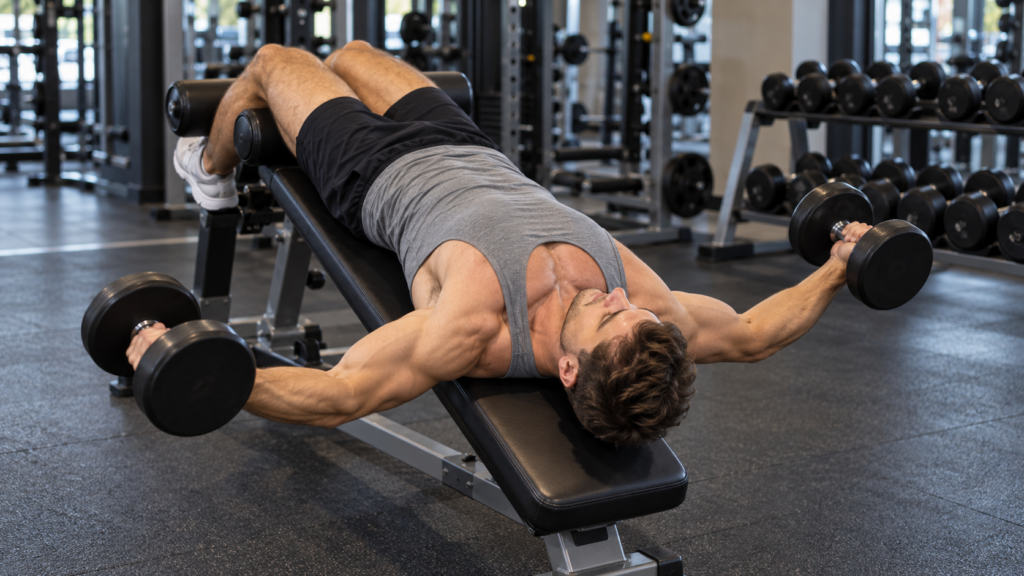
Walk into almost any gym on a Monday and every flat bench is usually taken. Monday has been chest day for so long that you’d think it was written into the membership agreement. And that’s actually a good thing because the one bench nobody is waiting on is the decline bench sitting over in the corner.
Why is that such a good thing, you ask? Well, first, like I said, it’s usually free. And second, the decline bench trains your lower chest, which is usually the part of the chest that gets the least attention. So before I give you the 4 exercises, I’m going to show you how your lower chest actually works. Then I’ll walk you through the 4 exercises, how to fit them into the chest days you already have, and how to keep adding weight to each one.
Before the exercises, let's look at some chest fundamentals
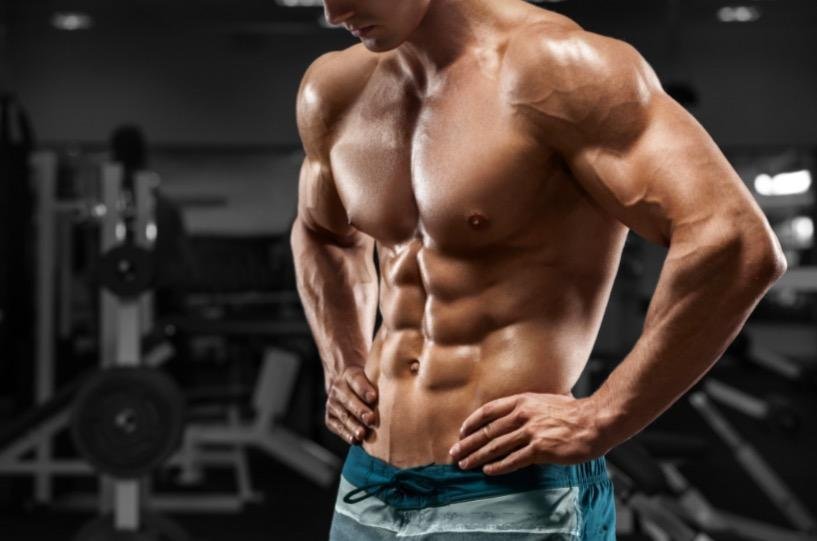
Your chest is one muscle, but its fibers don’t all start in the same place. The upper fibers start on your collarbone. The lower fibers start on your breastbone and along the cartilage of your ribs, and the lowest of them start just above your stomach. All of those fibers run out to the same spot near the top of your arm.
Because the lower fibers start below your shoulder, they pull your arm down toward your hip, while the upper fibers pull your arm up and forward. So if you pick exercises that move your arm down toward your hip, you put more of the work on your lower chest. That’s why it’s important to pick the right exercises so you can accurately target your lower chest.
2-MINIUTE CONFIDENCE QUIZ
Find out what's holding you back: your body, your style, or your dating life.
9 questions. You get a score for each and the one area to work on first.
Since every lower chest exercise works by moving your arms down toward your hips, you don’t need a long list of them. This post has 4, and they come in 2 pairs. The first pair is 2 presses. They’re where you can move the most weight, and your triceps and shoulders help out on every rep. The second pair is 2 flys, which take your triceps out of the exercise so your chest has to do all of the work on its own. In each pair, one exercise only needs dumbbells and a bench, and the other needs a dip station or a cable machine, so whatever equipment you have, you can still do a press and a fly.
And now, without further delay, let’s jump into our top 4 exercises for lower chest.
1. Decline Dumbbell Press
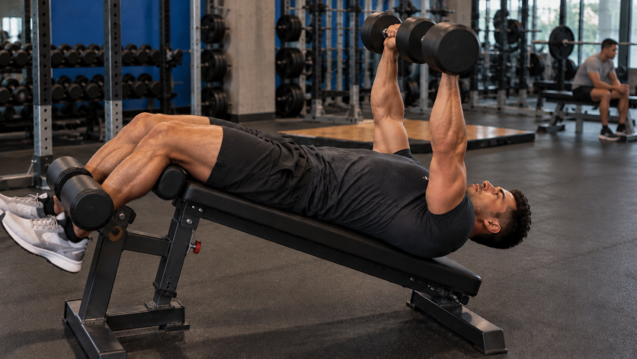
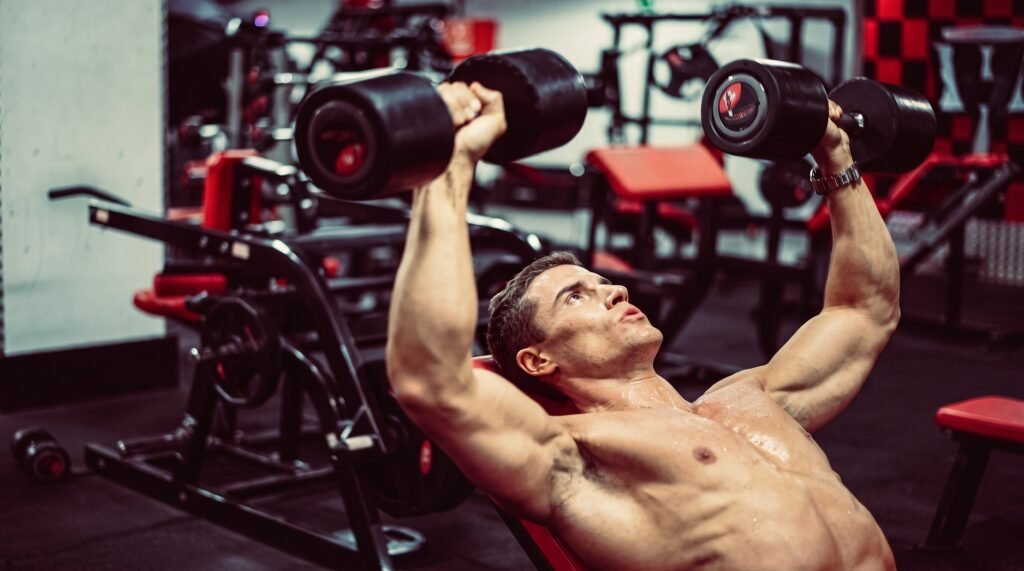
The decline press is a regular dumbbell press done on a bench that’s tilted so your head sits lower than your hips.
That tilt is what makes it a lower chest exercise, because it means an ordinary press now sends your arms down toward your hips, which is the direction your lower chest pulls your arm. Of the 4 exercises, the decline press is also the one where adding weight week after week is most realistic, so it’s the one to measure your lower chest progress by. Dumbbells beat a barbell here for the same reason the dumbbell chest guide gives. Your hands can come down past the point where a bar would stop on your chest, so your chest gets worked through a longer stretch.
The research on how much a decline bench adds for your lower chest is split. In a 1995 study, Barnett and his colleagues found the middle and lower part of the chest working harder on a flat bench than on a decline. In 2023, a review led by Abraham López-Vivancos pooled 23 studies and found the opposite for that same part of the chest, with the decline ahead. Both studies measured how hard the muscle was working during the lift, not how much it grew over the following months, so neither one settles the question. What you can take from them is that a decline gives your lower chest some extra work, not that it’s the only way to train it.
Getting into position on a decline bench is the trickiest part of this exercise, so here’s how to set it up step by step.
- Set the bench to a slight decline, around 15 to 20 degrees. Going steeper than that mostly just makes it harder to get in and out of the bench.
- Sit on the bench with your legs hooked under the pads and a dumbbell standing on each thigh.
- Pull the dumbbells in tight against your chest and lie back slowly until your back is flat on the bench.
- Press the dumbbells up over your lower chest, rather than over your face, until your arms are almost straight.
- Lower the dumbbells until your hands are just outside your ribs, keeping your elbows at about 45 degrees from your body instead of flaring them straight out to the sides. Then press back up for the next rep.
When the set is over, bring the dumbbells back down to your chest before you do anything else. Then tuck your chin and sit up with them held tight against you, the same way you got down. There’s no graceful way to sit up from a decline bench with a dumbbell in each hand, and the guys who make it look easy are usually using lighter dumbbells than you’d guess.
Where most guys go wrong on the decline press is treating it like their flat press and using the same weight. Your head is below your hips, there are 2 dumbbells over your chest, and if a rep stalls, the only way out is to let the dumbbells drop out to your sides. Keep the weight moderate and save your heaviest pressing for the flat bench.
Sets and reps: Do 3 sets of 10 to 12 reps, stop each set with 2 clean reps left, and rest 2 to 3 minutes between sets.
2. Chest Dips
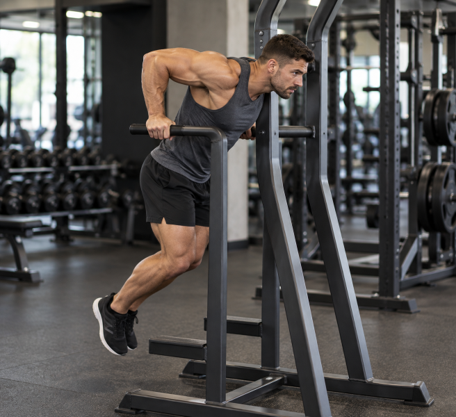
Dips are by far my favorite exercise on this list and the one I look forward to the most. They’re one of the best ways to train your lower chest, and they’re also just fun to do. When I’m in a phase where I’m training for higher reps, dips are where I feel my endurance building the most, and because they work your triceps and shoulders along with your chest, you get a lot out of every set.
Dips move your arms down toward your hips like the other exercises, but on a dip you move your body instead of moving a weight. Your hands stay planted on the bars while your body rises up past them, so at the top of every rep your arms finish down by your sides, which is exactly where your lower chest pulls them.
Here’s how to set up a dip so your chest does the work instead of just your triceps.
- Grab the parallel bars and push yourself up until your arms are straight and your feet are off the floor. Crossing your feet behind you helps keep you from swinging.
- Lean your chest forward a little, so your body is tilted rather than straight up and down. The lean is what turns a dip into a chest exercise, because if you stay upright, most of the work goes to your triceps.
- Lower yourself slowly until your upper arms are about parallel to the floor, letting your elbows point back and a little out instead of flaring straight to the sides.
- Press yourself back up until your arms are straight again.
The mistake you’ll see most on dips is sinking as low as you can go to chase a bigger stretch. Once your shoulders drop below your elbows, your shoulder joints take on more of the load than they want to, and that’s the usual reason guys say dips hurt. Stopping at parallel still gives your chest plenty of work, and it keeps that extra strain off your shoulders.
Sets and reps: Do 3 sets of 8 to 12 reps, stop each set with 2 clean reps left, and rest 2 to 3 minutes between sets. If you can’t get 8 reps yet, the section on adding weight below covers how to work up to them.
3. High-to-Low Cable Crossover
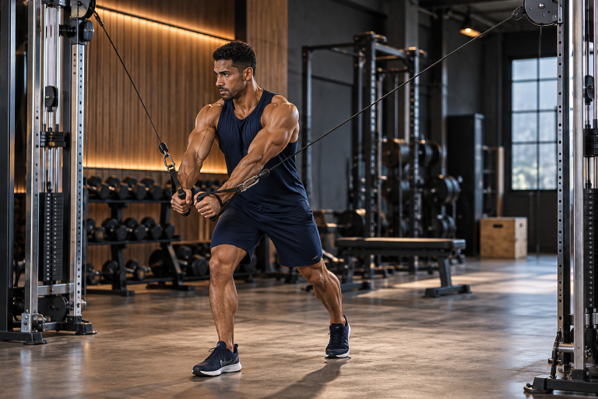
If you only have time for one exercise in this post, make it the cable crossover.
With the pulleys set high, the cables pull your arms up and out, and every rep is you pulling them down and together in front of your hips. That’s the exact direction your lower chest pulls your arm, so of the 4 exercises in this post, the crossover lines up with it most closely. Cables also keep pulling on your arms through the whole rep, including the bottom, where your hands meet and your lower chest is working hardest. Dumbbells can’t keep that pressure on at the bottom of the rep, and that’s the biggest difference between the crossover and the decline fly.
You’ll need a cable station with 2 pulleys that go all the way to the top, and the setup goes like this.
- Set both pulleys to the highest setting and grab a handle in each hand.
- Take a step or two forward so the handles pull your arms up and back, and stand with one foot a little in front of the other and a slight lean forward.
- With a soft bend in your elbows, pull the handles down and together in a wide arc until your hands meet in front of your hips. Think about bringing your elbows toward each other rather than your hands, since your elbows are what your chest is actually moving.
- Pause with your hands together at the bottom.
- Let the handles travel back slowly until your hands are about level with your shoulders, and then start the next rep.
That hold at the bottom is my favorite part of this exercise. I like to keep my hands together for 2 to 3 seconds on every rep, because that’s the position where your lower chest is working hardest, so it’s the best place in the rep to spend extra time. It also makes a light weight feel heavy in a hurry, which comes in handy because cable stacks only go up in big jumps.
The most common mistake is letting the cables pull your arms too far back on the way up. If the handles drag your arms back past your shoulders, the stretch moves out of your chest and into the front of your shoulder joint, which is not where you want it with weight attached. The other thing to watch is your elbows. If they bend and straighten as you go, the crossover turns into a press, and that’s a sign the weight is too heavy.
Sets and reps: Do 3 sets of 12 to 15 reps, stop each set with 1 or 2 clean reps left, and rest 60 to 90 seconds between sets.
4. Decline Dumbbell Fly
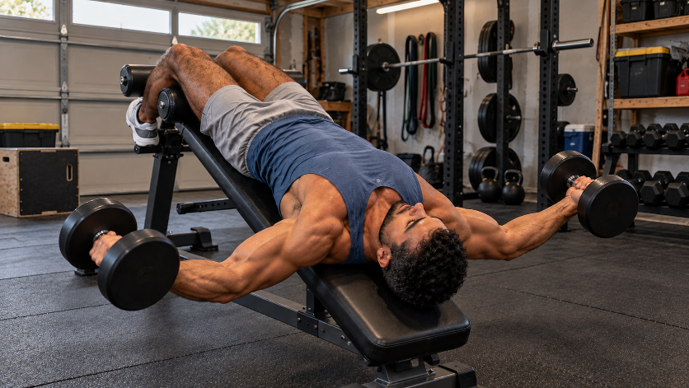
The decline fly is the option for anyone who doesn’t have a cable station, and you can do it on the same bench, at the same angle, that you already set up for the decline press.
It moves your arms in the same down-and-together direction as the crossover, and like any fly, it takes your triceps out of the exercise so your chest has to do all of the work. The difference from the cable version is where the work happens. A dumbbell only pulls hard against your chest when your arms are out wide. As the dumbbells come up over your chest, gravity starts pulling straight down through your arms instead, so with dumbbells, the bottom half of the rep is where your chest does most of its work.
The setup is almost the same as the decline press.
- Keep the bench at the same slight decline, 15 to 20 degrees, and hook your legs under the pads.
- Lie back with the dumbbells held over your lower chest, your palms facing each other and a soft bend in your elbows.
- Open your arms out to the sides in a wide arc and lower the dumbbells until you feel a good stretch across your chest. Keep the bend in your elbows the same the whole way down, and stop before your hands drop below the level of the bench.
- Bring the dumbbells back up along the same arc, squeezing your elbows toward the middle of your chest, and stop when the dumbbells are a few inches apart.
On the decline fly, the mistake almost everyone makes is bringing the dumbbells all the way together at the top and clanking them. Since your chest has almost nothing left to do once the dumbbells are over it, the clank makes a nice sound and that’s all it does. And just like on the crossover, if your elbows start bending and straightening on every rep, you’re doing a press instead of a fly, so take 5 pounds off each hand.
Sets and reps: Do 3 sets of 12 to 15 reps, stop each set with 1 or 2 clean reps left, and rest 60 to 90 seconds between sets.
How to fit these into the chest days you already have
You don’t need a lower chest day, and you definitely don’t need all 4 of these exercises in one session. Your chest grows best when you train it twice a week with at least 48 hours between sessions, and across the whole week, about 11 to 15 working sets of chest is the range to aim for. Any sets you do of these 4 exercises count toward that weekly total, rather than getting added on top of it.
On each chest day, do your main press first while you’re fresh, and then add 1 lower chest exercise after it. Here’s one way to lay out the week.
Day 1:
- Flat dumbbell press, 3 sets
- Incline dumbbell press, 2 sets
- High-to-low cable crossover or decline dumbbell fly, 3 sets
Day 2:
- Incline dumbbell press, 3 sets
- Chest dips or decline dumbbell press, 3 sets
That adds up to 14 sets of chest for the week. Incline pressing shows up on both days on purpose, because for most guys the upper chest is the part that needs the most help, and it’s the part that shows in a shirt. Before your first working set on either day, do 1 or 2 light sets of that same press to get your shoulders and elbows ready. Those warm-up sets don’t count toward the 14. And if Monday is your chest day, you can keep it. Just add a second chest day later in the week.
Every set in this post ends with 1 or 2 clean reps still left in you. That isn’t you going easy on yourself. Taking every set all the way to failure piles up more fatigue than your body can recover from between chest days, so grinding out that last rep today usually costs you reps in your next few sessions.
The sets and reps in this post are suggestions, not rules. Heavier weight for fewer reps and lighter weight for more reps both build muscle, so if a different setup keeps you showing up, sits better with your joints, or fits your schedule, use that one, as long as every set still ends with 1 or 2 clean reps left in you. What matters is that you train your chest twice a week and keep adding reps or weight over time. If you’d rather have the whole week planned out for you, my book Lean Into Muscle has 3 ready-to-use workout templates, for 3, 4 and 5 training days a week, built on the same rules as this post.
How to add weight on each one
Picking the right 4 exercises only gets you started. What actually builds your chest is doing a little more than last time, week after week, which is called progressive overload. Each week, try to beat what you did the week before, whether that’s 1 more rep, the next weight up, or cleaner form on a rep that was getting sloppy. Write down the weight and the reps every session, because you can’t beat a number you don’t remember.
When to move up in weight depends on how long you rest. On the 2 presses, you’re resting 2 to 3 minutes, which is long enough to hit about the same reps on every set. So stay at a weight until every set reaches the top of the range with 2 reps left, and then move up and drop back to the bottom of the range. For example, once you’re doing 3 sets of 12 on the decline press with the 40s, move to the 45s and start back at 10.
On the 2 flys, you’re only resting 60 to 90 seconds, so your reps will drop from one set to the next even when you’re doing everything right. Move up when your first set hits 15 reps with 1 or 2 left, and expect the later sets to come in lower, something like 15, 13 and 11.
Each of the 4 exercises also has its own problem when it comes to adding weight.
On the decline press, dumbbells go up in 5-pound jumps, and past the 50s, a lot of racks switch to 10. That’s a big jump to take with both arms at once, so use every rep in the range before you move up.
Dips are the only exercise here where the weight is you. If you can’t get 8 reps yet, use the assisted dip machine or loop a resistance band over the bars and under your knees, and use less assistance as you get stronger. Once you can do 3 sets of 12 with 2 reps left, add weight with a dip belt or by holding a dumbbell between your feet, starting with something small like 10 pounds. Keep your bodyweight in mind too. If you’re losing weight, your dips get easier without you getting any stronger, and if you’re gaining, they get harder, so check the scale before you decide you’ve stalled.
Both flys have the same problem, which is that the weights are light, so every jump up is a big one. Cable stacks usually go up 10 to 15 pounds per pin, and on a crossover, where you might only be using 20 or 30 pounds a side, a 10-pound jump means a third to half more weight in one step. Fly dumbbells work the same way, since going from the 20s to the 25s is a 25 percent jump. So on both, get everything you can out of a weight first by using the full 15 reps and lowering slowly, keep the 2 to 3 second hold on the crossover, and when you do move up, expect your reps to drop for a week or two.
There’s a longer version of all of this in the progressive overload guide.
Common questions
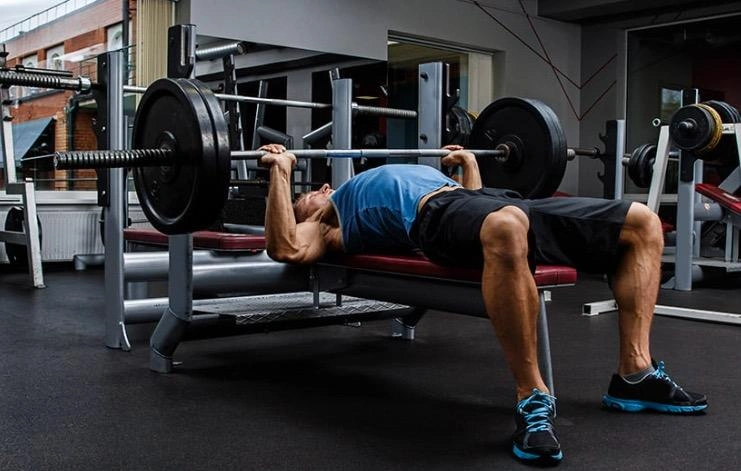
Can I use a barbell on the decline bench instead? Yes, as long as someone is there to spot you. A barbell lets you go heavier than dumbbells, and a decline bench with a rack lets you set the bar down between sets. The trade-off is that the bar stops when it hits your chest, so you lose the extra few inches of stretch at the bottom that dumbbells give you. Use the same 3 sets of 10 to 12 either way.
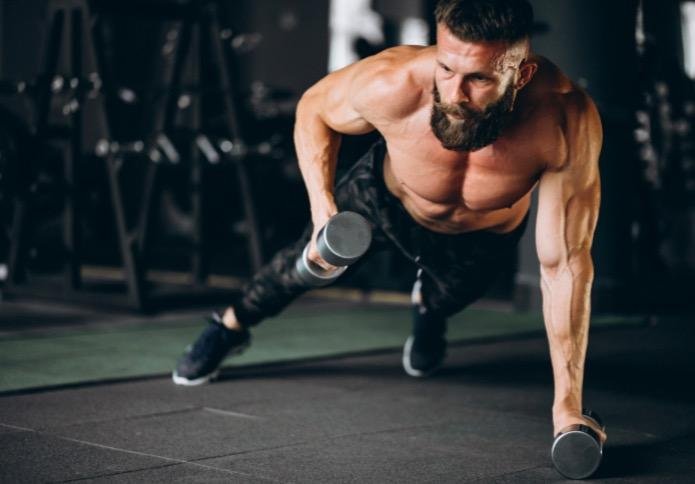
Can I train my lower chest at home? Yes, if you have dumbbells and a bench that declines, because the decline press and the decline fly need nothing else. Without a bench, push-ups with your hands up on a sturdy step or a kitchen counter work too. Just make sure it’s your hands that go up and not your feet. Raising your hands angles your arms down toward your hips the way a decline press does, while putting your feet up turns the push-up into something closer to an incline press, which is great for your upper chest and not what you came here for.
Why can’t I see a line under my chest? The bottom edge of your chest only shows when there isn’t much fat sitting over it, so a lot of the time that line has more to do with your diet than with your exercise list. These 4 exercises build the muscle, and getting leaner is what lets people see it.
Why do dips hurt my shoulders? Usually because you’re going too deep or staying too upright, which are the 2 fixes in the dips section: stop at parallel and lean forward. If dips still bother you after both fixes, swap in the decline press. It trains the same part of your chest, and there’s no reason to keep doing an exercise that hurts when another one does the same job.
Readers Also Read