5 Best Dumbbell Chest Workouts To Sculpt Perfect Pecs
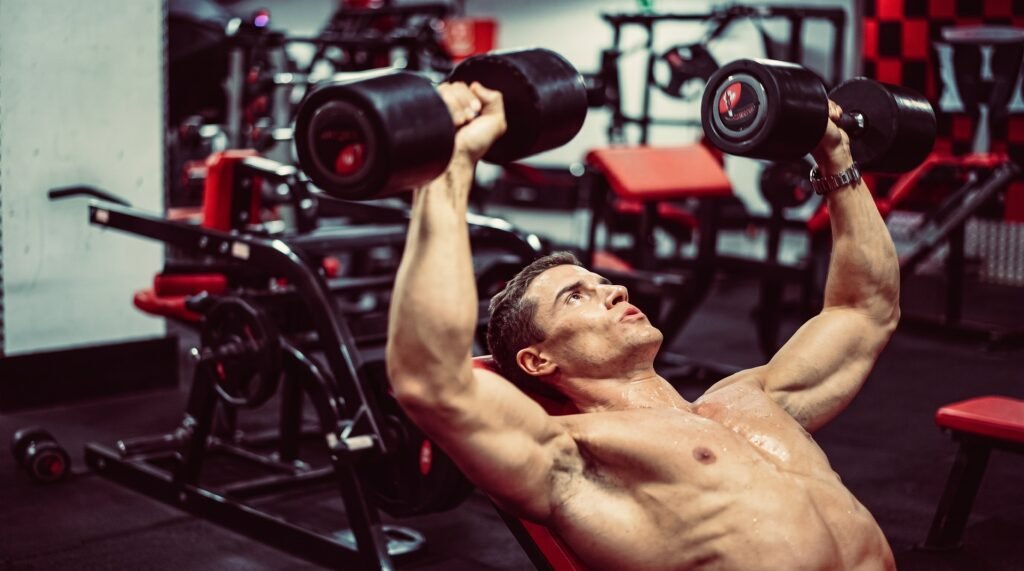
Stand at the back of any gym for ten minutes and watch the guys on the dumbbell benches. Almost all of them press the same way. The weights come down until their elbows are about level with their ribs, stop there for a beat, and go back up. It looks fine, and it looks like a chest press, and it’s about two-thirds of one.
The few inches underneath where everybody stops are the only thing a dumbbell does that a barbell can’t, which makes them the entire reason to be holding dumbbells in the first place. Leave them out, and you’ve basically done a barbell bench press with a more annoying setup and worse leverage, and I’m not sure why anybody would sign up for that.
So here are the 5 dumbbell chest exercises worth your time, what each one is actually for, and how to get down to the bottom of the rep when there’s nobody standing behind you to save you.
Before the exercises, one thing about chest shape
There’s no such thing as an inner chest.
2-MINIUTE CONFIDENCE QUIZ
Find out what's holding you back: your body, your style, or your dating life.
9 questions. You get a score for each and the one area to work on first.
Your pec is one muscle. The fibers run from your sternum and your collarbone out to the top of your arm, and they all pull in roughly the same direction, so there’s no separate strip down the middle sitting there waiting to get carved out by squeezing at the top of a rep. When somebody says a guy has good inner chest definition, what they’re looking at is a bigger chest on a leaner body. Neither of those is an exercise.
What you can change is upper against lower. The fibers coming off your collarbone sit at a different angle to the ones coming off your sternum, so tilting the bench really does move the work between them. That part is true, and it’s the reason the list below is put together the way it is.
Why a dumbbell beats a barbell here
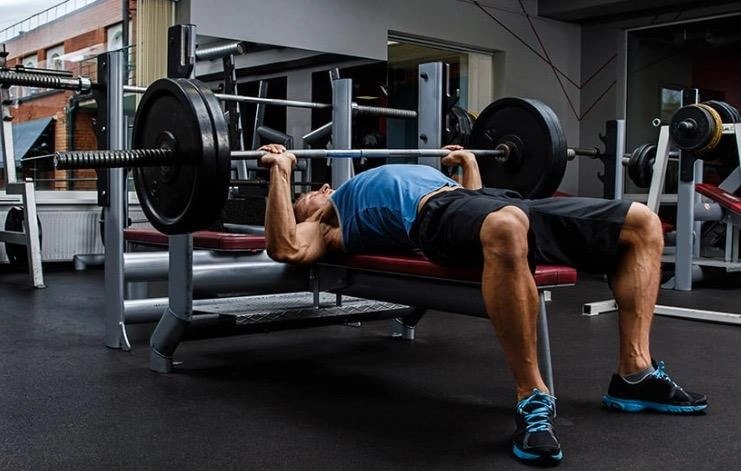
Lie down with a barbell and take it to your chest, and then have a think about why it stopped. It stopped because it ran into you. Your chest still had somewhere to go.
Dumbbells don’t run into you, so your hands carry on past the point where the bar would have parked itself, and your chest ends up loaded in a stretched position it otherwise never sees. A good chunk of the growth comes from down there, and it’s also the exact part of the rep that nearly everybody leaves out. That’s most of the argument for dumbbells, and honestly it’s most of the argument for this post.
A couple of smaller things come along with it. Each arm has to carry its own weight, so the side that’s been quietly coasting behind your stronger one runs out of places to hide. And your hands can rotate as you press instead of being bolted to a fixed bar, which for a lot of guys is the difference between a chest day and a shoulder that grumbles until Thursday.
Three angles, two ways to load the stretch
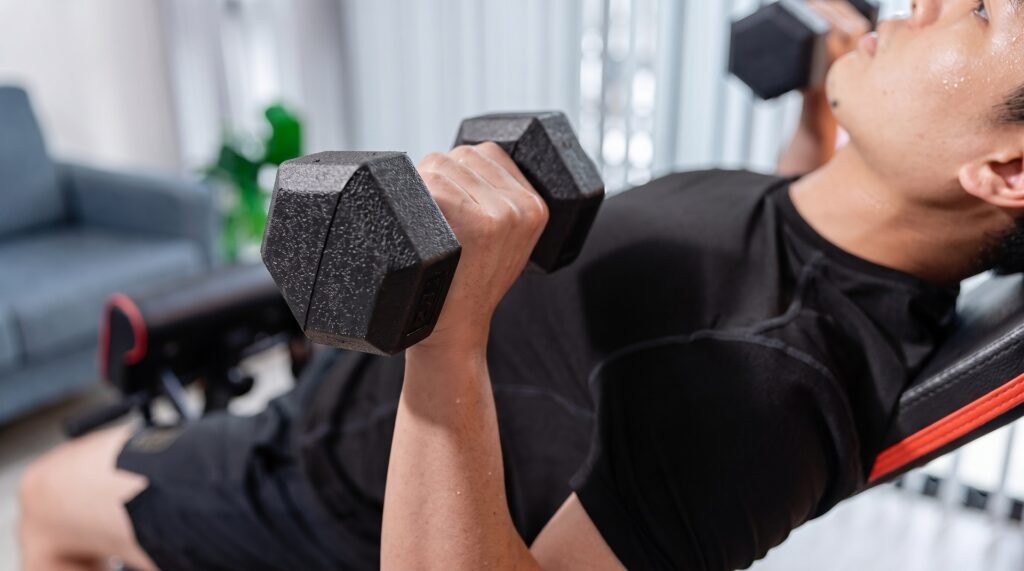
That’s the plan, and it’s why there are 5 exercises down there instead of 9. Flat is where you move the most weight and load the whole muscle at once. Incline points your arms higher and shifts work onto the fibers off your collarbone. That’s the part that fills out the top of a shirt and the part most guys are furthest behind on. Decline goes the other way and builds the bottom edge, the line you only really notice from the side.
Then there are two movements in here that exist purely to load the stretch. The fly takes your triceps out of it completely. The pullover puts your arms overhead, and no press on earth is getting you into that position.
1. Flat Dumbbell Bench Press
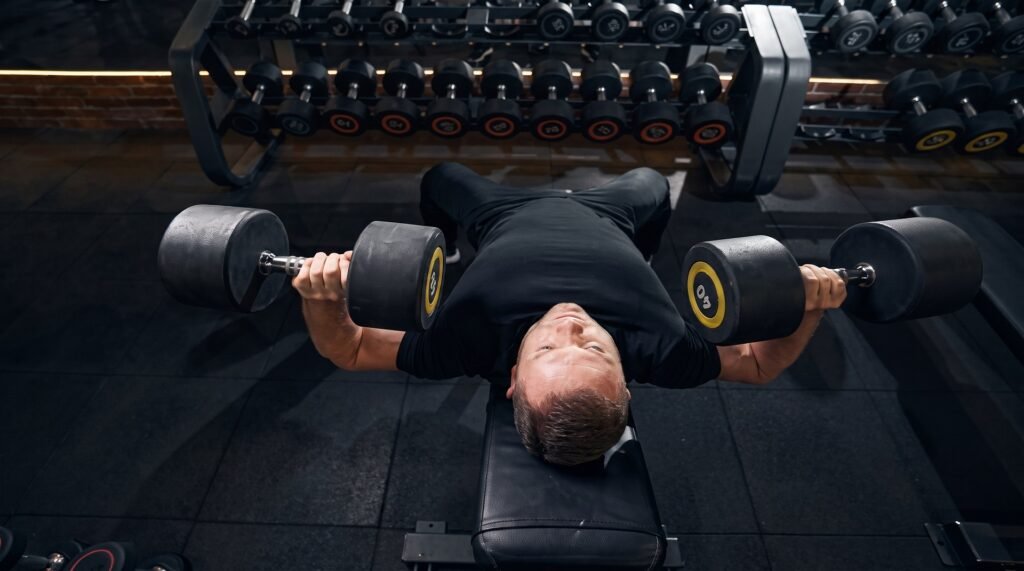
This is the one the rest of the session gets built around.
Why it’s in here: It loads the whole pec at once, and it’s where you can actually move some weight, which makes it the exercise you should be trying to beat from one week to the next.
How to do it: Sit on the end of the bench with a dumbbell standing up on each thigh. Lie back and kick them into position one at a time. Feet flat, shoulder blades pulled back and down into the bench. Press up until your arms are nearly straight, without clanging the dumbbells together at the top like you’re finishing a set on television, then lower until your hands are level with your chest or a bit below.
Sets and reps: 4 sets of 6 to 10. Rest 2 to 3 minutes.
The mistake: Letting your elbows flare straight out to the sides. Keep them at something like 45 degrees from your body. It’ll feel weaker for a week or two, and your shoulders will thank you for considerably longer than that.
QUICK CHECK
If someone asked you to take your shirt off at the beach tomorrow, how would you feel about it?
2. Incline Dumbbell Press
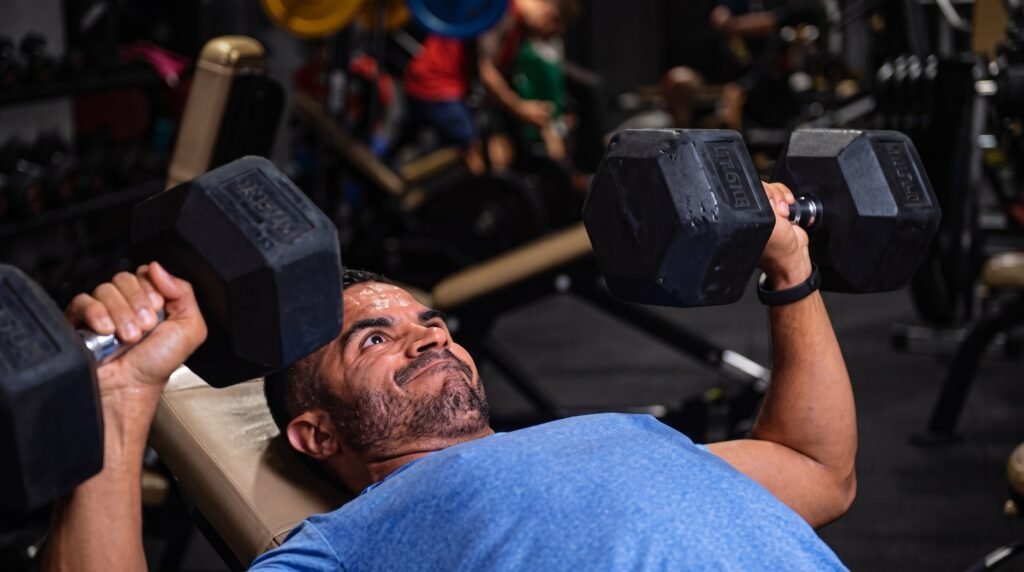
This is the one that decides whether your chest looks like it starts at your collarbone or somewhere around the middle of your ribs.
Why it’s in here: Tilting the bench points your arms up and moves work onto the fibers running off your collarbone. It’s the bit almost everybody under-trains, and it’s the bit that shows in a shirt.
How to do it: Set the bench to about 30 degrees. Press it the same way you press on flat, shoulder blades pinned, lowering until you feel the stretch across the top of your chest.
Sets and reps: 3 sets of 8 to 10. Rest 2 to 3 minutes.
The mistake: Cranking the bench too high. Past about 30 degrees, you stop adding chest and start handing reps over to your front delts, and by the time you’re sitting at 60, you’re doing an awkward shoulder press and calling it chest day. If your bench only has fixed notches, take the first one above flat and leave it there.
3. Decline Dumbbell Press
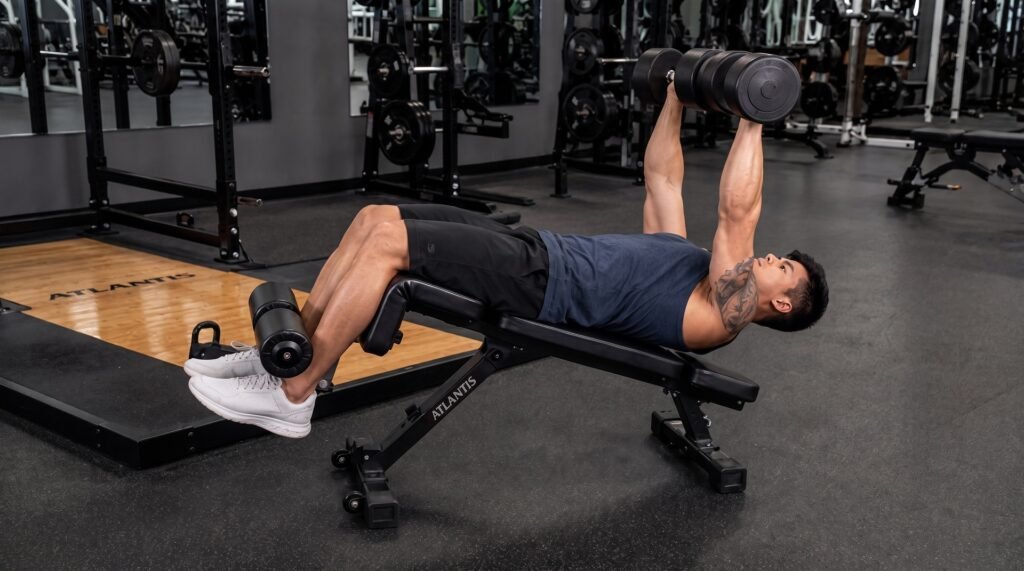
This one builds an edge instead of a slope.
Why it’s in here: It sits at the opposite end of the range from the incline, and it builds the line along the bottom of your pec, the one you only really see from the side. It also means this whole list runs off a bench and a pair of dumbbells with no dip station anywhere in it.
How to do it: Set a slight decline; 15 or 20 degrees is plenty, and hook your legs under the pads. Press up over your lower chest rather than over your face, then lower until your hands are just outside your ribs.
Sets and reps: 3 sets of 10 to 12. Rest 90 seconds to 2 minutes.
The mistake: Treating it like flat and going heavy. Getting in and out of a decline while holding two heavy dumbbells on your own is genuinely awkward, and upside down with a load over your chest is the last place you want to be when finding your limit. Keep it moderate here. The flat press is where the heavy work lives. If you want more on this end of things, I went further into it in the lower chest guide.
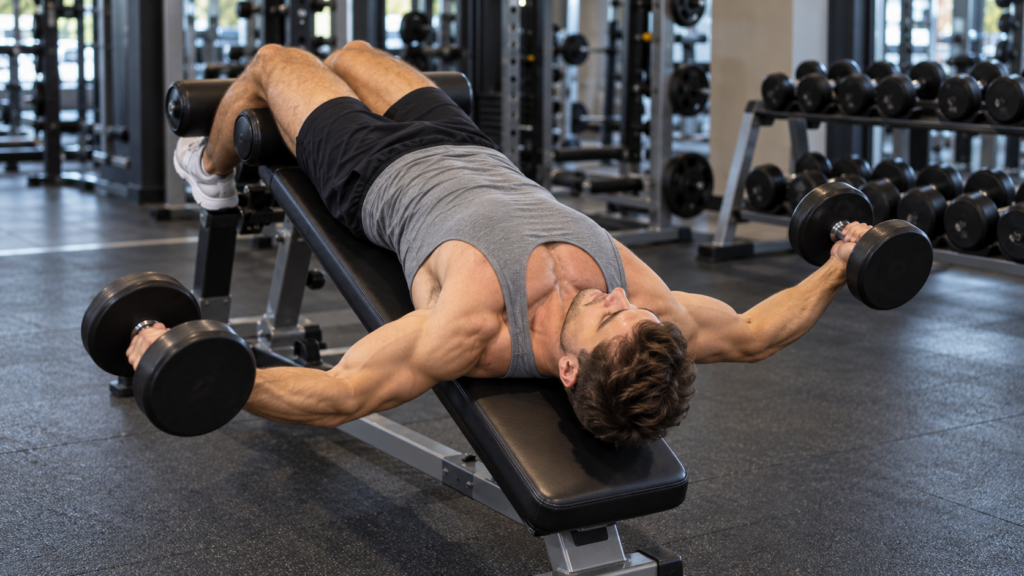
4. Dumbbell Chest Fly
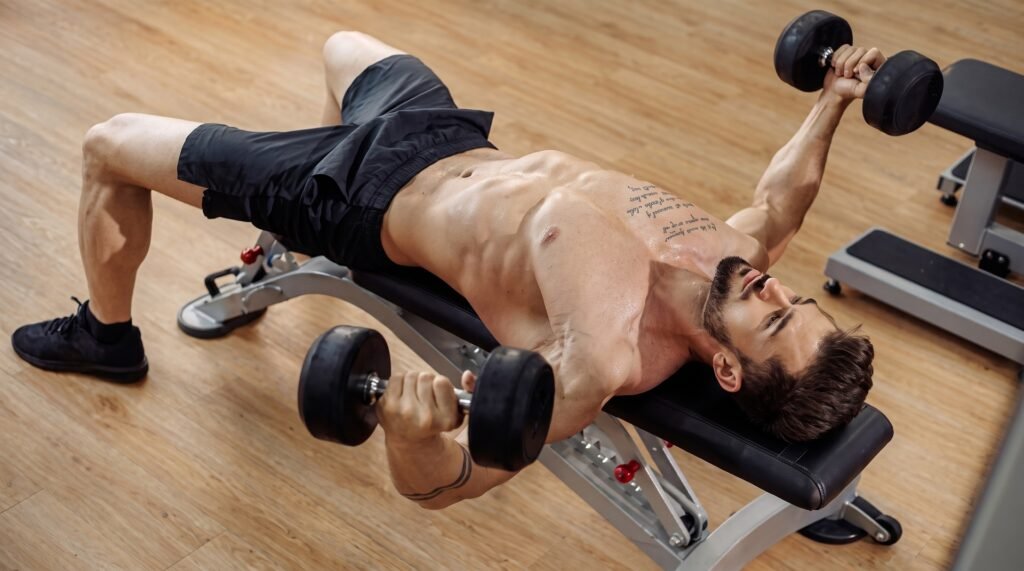
This is where your chest finds out it’s been getting help.
Why it’s in here: Your triceps sit this one out completely. On every pressing movement, they’re taking a cut whether you notice it or not, and once you take them out of the equation, your chest has to do the whole job on its own, through the deepest stretch on the list.
How to do it: Lie flat, dumbbells above your chest, elbows softly bent. Open your arms out wide and lower until you feel a proper stretch across your chest, then bring them back together like you’re closing a heavy door. The elbow angle doesn’t change at any point in the rep.
Sets and reps: 3 sets of 12 to 15. Rest 60 to 90 seconds.
The mistake: Going too heavy and letting your elbows bend and straighten as you go. Once that’s happening, you’re pressing. Take 10 pounds off each hand and do it properly, and it’ll be harder than the version you were cheating, which annoys people every single time.
5. Dumbbell Pullover
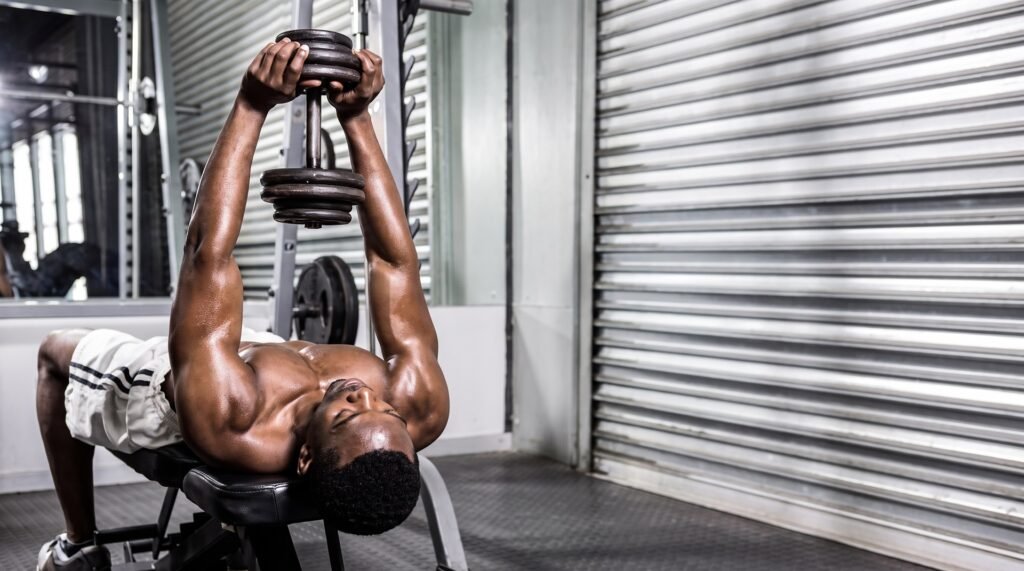
This is the one on the list that isn’t really a chest exercise, and it’s staying anyway.
Why it’s in here: It puts your arms overhead, and that’s a stretch you can’t get to with any press or any fly. It builds your lats and serratus on the way through as well, and nobody has ever complained about that.
How to do it: Lie flat on the bench, hold one dumbbell with both hands over your chest, elbows slightly bent. Lower it back behind your head until you feel the stretch, then pull it back over your chest.
Sets and reps: 3 sets of 10 to 12. Rest 60 to 90 seconds.
The mistake: Believing it expands your rib cage. Somebody will tell you this eventually, usually the oldest guy in the gym, and it isn’t true. Your rib cage stopped changing size around the time you stopped growing. Do them for the stretch; that part’s real.
Getting the dumbbells up when nobody's spotting you
Here’s the part I said I’d come back to, and it’s the reason most people never train the bottom of the rep at all.
Getting a pair of 80s into position is a leg movement, not an arm movement. Sit on the end of the bench with a dumbbell standing on each thigh up near your knee, lean back, and kick with your legs one side at a time so each one rides up as your back comes down onto the bench. If you’re hoisting them up there with your shoulders, you’ve done the hardest set of the day before the set has started, and you will feel it around rep three.
Coming out is the same thing in reverse. Bring them into your chest, tuck your chin, sit up, and let your legs do the work. Don’t lower them to the floor from lockout. That’s how people get hurt at the end of a set they’d already finished.
And if a rep stalls halfway up, just let the dumbbells go out to the sides. That’s the whole safety plan, and it’s been enough for everyone I know who trains on their own.
Which brings up training to failure. On a cable curl, you can go until the rep genuinely won’t move, because the worst thing that happens is the handle goes back down, and you look mildly annoyed. A dumbbell press is the other end of that. There’s no rack to set it on, nobody to lift it off you, and the position you fail in has two dumbbells sitting directly above your face.
So on the presses, stop while you’ve still got 1 or 2 clean reps in you. That isn’t you going easy on yourself. Stopping a rep or two short builds the same muscle as grinding all the way into failure; it costs you less recovery, and the numbers you write down are numbers you can actually repeat next week. That’s the entire point of writing them down. Save the real failure for your last set of flys or pullovers, where nothing is hovering over your head.
How to actually add size over time
None of the 5 exercises up there do anything on their own. What builds a chest is doing them with slightly more work than last time, over and over, for longer than you want to. That’s progressive overload, and dumbbells have a very specific problem with it.
The rack goes up in 5-pound jumps, and once you’re past 50 or so, most racks switch over to 10-pound jumps. Going from the 50s to the 60s is a 20 percent increase taken in one step, by both arms at the same time, with nothing in between to ease you into it. You can’t just add weight every week even if you’re getting stronger every week, because the rack won’t let you.
So the order goes like this. You add reps before you add weight, so if you’re on 4 sets of 6 with the 60s, you spend the next few weeks working your way up to 4 sets of 10 with that same pair. Then you move up and drop back down to 6, and you’ll be stronger at the new weight than you were the day you first picked up the old one. And write it down, all of it, weight, sets and reps every session, because if you can’t tell me what you did last chest day, then you’re not overloading anything; you’re just going to the gym, which is a perfectly good hobby. It’s a slow way to build a chest.
Do that for 3 months, and the exercises above will have done what they’re there to do. Skip it, and you can have textbook form forever at exactly the same weight. There’s a longer version of all this in the progressive overload guide if you want it.
How to put these together
You don’t need all 5 in one session, and you shouldn’t be training chest once a week.
Day 1 is the heavy one: flat dumbbell bench press, incline dumbbell press, dumbbell chest fly. Day 2 is angles and stretch: incline dumbbell press, decline dumbbell press, dumbbell pullover. Leave 48 to 72 hours between the two.
Incline turns up on both days on purpose. It’s the angle most people are furthest behind on, and it’s the one that changes how you look in a shirt, so it gets twice the attention. Before your first working set on either day, do two light sets of whatever you’re about to press. Not a whole warm-up routine, just enough that your shoulders know what’s coming.
Common questions
Can I build a real chest with only dumbbells?
Yes. A barbell’s main advantage is that you can load it heavier, which matters a lot if the number on your bench press is the point of the exercise. If chest is the point, dumbbells give you more range and force both sides to work, and plenty of guys have built one with a bench, a rack of dumbbells, and nothing else in the room.
Can I do all of this at home?
Yes, and that’s why the list looks the way it does. All 5 of these need dumbbells and an adjustable bench. No dip station, no cable stack, no rack.
How often should I train chest?
Twice a week, 48 to 72 hours apart. Once a week will hold onto what you’ve already got, but it’s slow going. More than twice, and the later sessions are usually just getting in the way of the earlier ones.
How heavy should the dumbbells be?
Heavy enough that the last rep of your range is genuinely hard, light enough that you could have got 1 or 2 more out of it. If you’re hitting 12 on a set of 6 to 10, go up. If you’re grinding out 4, come down. Nobody’s watching.
Why do my shoulders hurt after chest day?
Nine times out of ten, it’s elbow position. Flared elbows put your shoulder in the position it likes least while it’s carrying a load. Tuck them to about 45 degrees, drop your incline to 30 or under, and see whether the problem disappears before you decide you’ve got an injury.
How long before I see a difference?
Two sessions a week with real overload, and you’ll feel it in about a month; see it somewhere between 8 and 12 weeks. Chest is slower than arms because it’s a bigger muscle, and there’s more of it to fill in.
Where to start
If you take one thing out of all this, take the bottom of the rep.
Next chest day, put 10 pounds less in each hand than you’d normally grab and go all the way down on every single rep. It’ll feel like you’re going backward for a couple of sessions, and your ego is going to hate it. Then write down what you did, and beat it next week.
Readers Also Read