6 Best Bicep Cable Workouts for Massive Arms
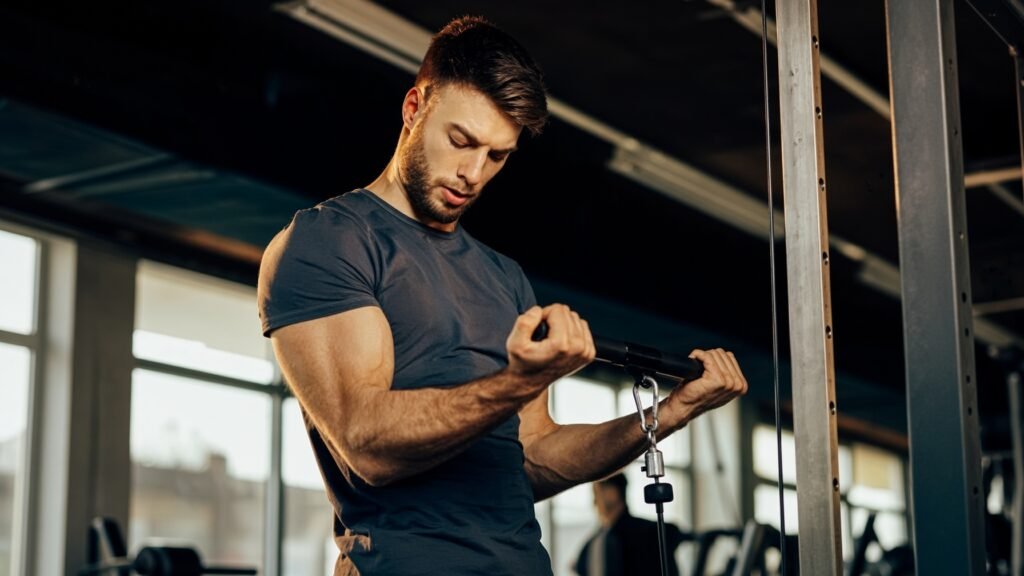
Walk into any gym, and there’s a line at the cable stack. Walk past it an hour later, and everyone is doing a version of the same curl, standing square to the machine with their elbows pinned to their ribs.
That curl is fine. It’s also a dumbbell curl with extra steps.
Cables can do one thing a dumbbell physically cannot, and hardly anybody uses them for it. Once you know what that is, the cable stack stops being the thing you use when the dumbbells are taken and starts being the reason your arms look different six months from now.
So here are the 6 cable exercises worth your time, what each one is actually for, and the one almost everybody leaves out.
Before the exercises, a quick word about arm size
Your biceps are not most of your arm.
Your triceps are. Depending on who’s measuring, the triceps make up somewhere between 60 and 70 percent of your upper arm, which makes them roughly twice the size of the biceps. That’s why a guy with big biceps and neglected triceps still has arms that look flat from the side, and why the fastest way to add visible size to your arms is usually to stop ignoring the back of them.
None of that makes curls a waste of time. The biceps are what people see from the front; they’re what fills the top of a T-shirt sleeve, and they respond quickly once you train them properly. Just know that this post is one part of the job. If you want the other two-thirds, read the triceps guide next.
Check out the ultimate guide to building horseshoe-sculpted triceps.
Why a cable beats a dumbbell for curls
Pick up a dumbbell and curl it slowly, and pay attention to where it feels hard. It’s hard in the middle. At the bottom, with your arm hanging straight down, there’s almost nothing on the muscle. At the top, with the weight stacked over your elbow, there’s almost nothing again. A dumbbell curl only really loads your biceps through the middle third of the movement, because gravity pulls straight down and your forearm spends most of the rep pointing somewhere other than sideways.

A cable pulls in whatever direction you point it. Set the angle right, and the tension stays on the muscle from the moment your arm is straight to the moment it’s fully bent. That’s the first advantage, and it’s the one most people already half know.
Here’s the second one, and it’s bigger. The long head of your biceps crosses your shoulder as well as your elbow, which means it only reaches a full stretch when your arm is behind your body. A dumbbell cannot load that position, because the second your arm goes behind you, the weight just hangs. A cable can, because the resistance is coming from behind you in the first place.
That single fact is the reason to walk to the cable stack instead of the rack, and it’s the thing almost no cable curl article mentions.
QUICK CHECK
If someone asked you to take your shirt off at the beach tomorrow, how would you feel about it?
Three positions your biceps need to see
Your biceps have two heads, plus a muscle called the brachialis sitting underneath it. Where your elbow is relative to your torso decides which one does most of the work, and that’s the whole logic behind the 6 exercises below.
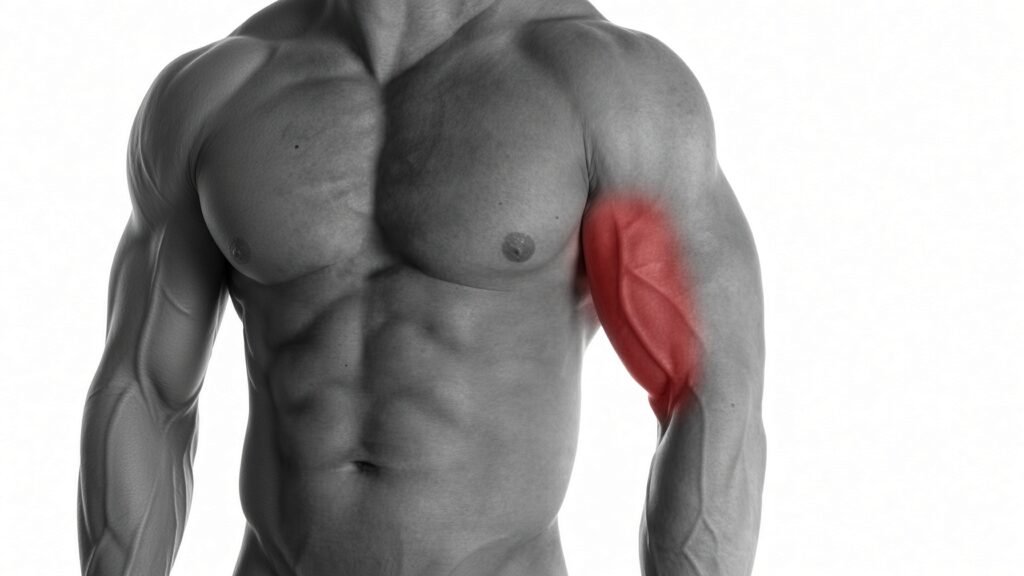
Arm behind your body puts the long head under a stretch. This is the position almost everybody skips, and the long head is the one that gives your arm its peak.
Arm in front of your body shortens the long head and shifts the work to the short head, which sits on the inside of your arm and adds thickness when you’re looking at yourself straight on.
Neutral grip, palms facing each other, brings in the brachialis. It sits under the biceps, and building it pushes the biceps up from below. If you want arms that look wider from the front, this is the muscle doing it.
Six exercises, all three positions covered. That’s the plan.
1. Bayesian Cable Curl
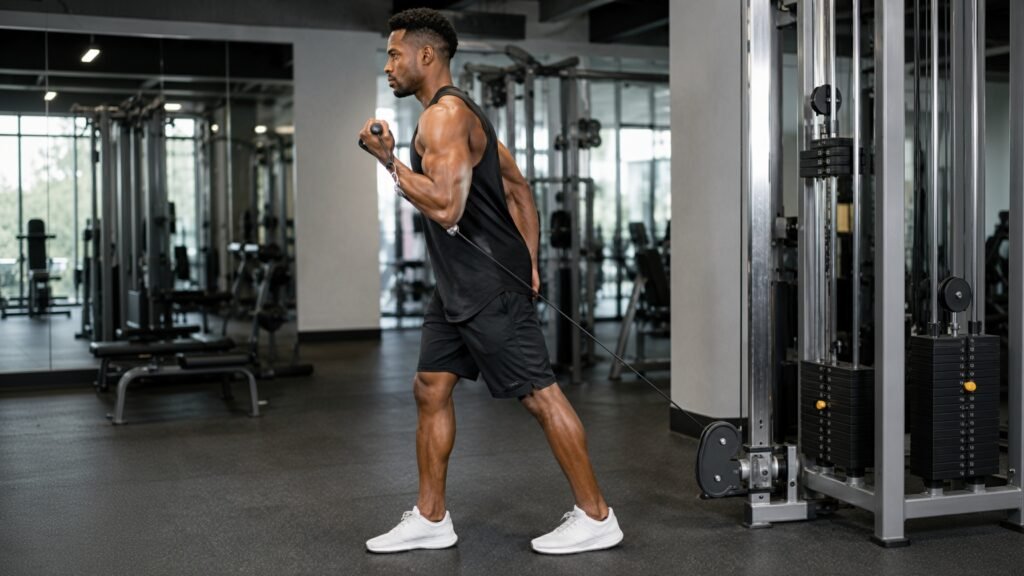
This is the one almost nobody does, and it’s the reason this whole list is on a cable machine instead of a dumbbell rack. You’ll also see it called a face-away curl or a behind-the-body cable curl.
Why it’s in here: This is the only exercise on the list that loads your biceps in a full stretch, with your arm behind your torso. That’s the long head’s best position, and a dumbbell cannot reproduce it.
How to do it: Set the pulley to its lowest setting and clip on a single handle. Stand with your back to the stack, take the handle in one hand, and step forward a foot or two so the cable runs behind you. Lean forward slightly at the hips and rest your free hand on your thigh. Let your working elbow settle about an inch behind your side and let the cable pull your arm straight until you feel the stretch. Curl the handle up toward your shoulder without letting your elbow drift forward, then lower it under control and let it stretch again.
Sets and reps: 3 sets of 10 to 12 per arm.
The mistake: Letting your elbow travel forward as you curl. The moment it comes in front of your body, you’ve turned this back into an ordinary curl and given away the only reason you’re doing it. If the cable catches your wrist, lean a little further forward.
2. Cable Curl
This is your bread-and-butter curl and the one you’ll load heaviest.
Why it’s in here: It’s the standard position, arms at your side, both heads working, and it’s where you can move real weight with the tension staying constant top to bottom.
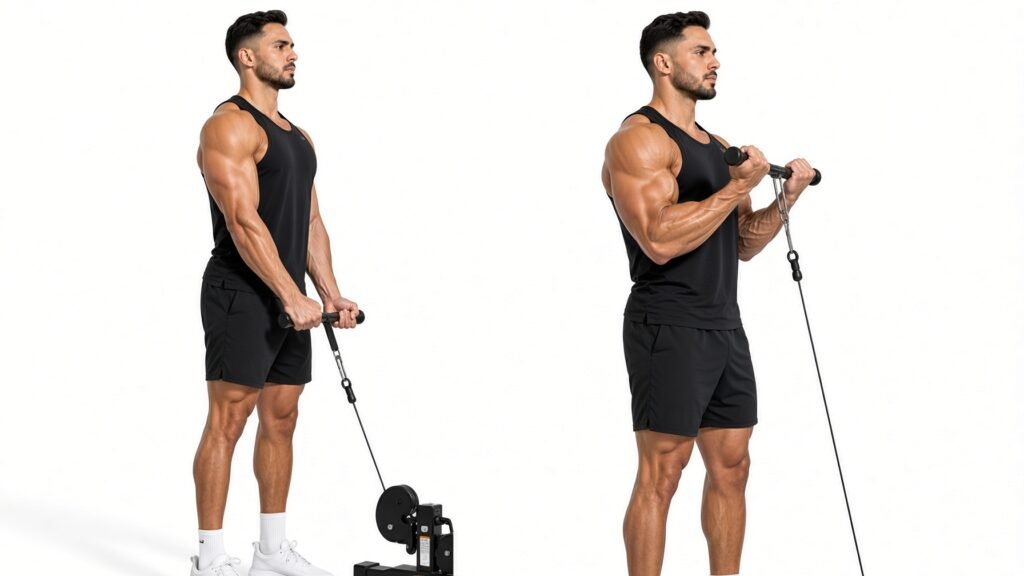
How to do it: Attach a straight bar or an EZ bar to the low pulley. Stand a step back from the machine with your feet about shoulder-width apart and take an underhand grip. Keep your elbows tucked against your ribs and curl the bar to shoulder height, then lower it all the way until your arms are straight.
Sets and reps: 3 to 4 sets of 8 to 12.
The mistake: Rocking backward to get the bar moving. If your shoulders are swinging, the weight is too heavy and your lower back is doing a job your biceps should be doing.
3. Cable Hammer Curl
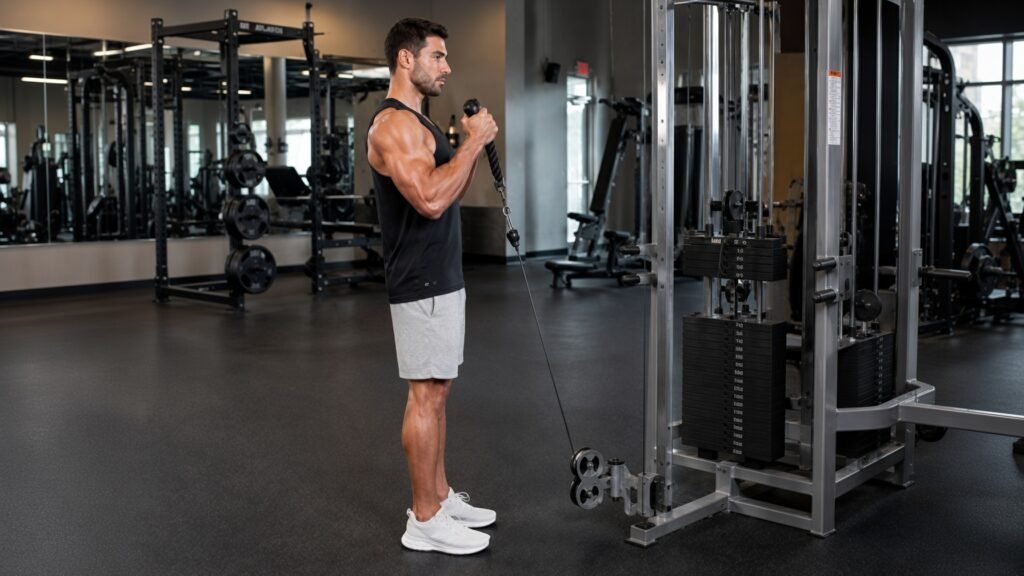
This is the exercise that makes your arm look wider rather than just higher.
Why it’s in here: The neutral grip brings the brachialis into it, and the brachialis sits underneath your biceps. Build it, and it pushes everything above it up. It’s also the friendliest curl on the list if your wrists or elbows complain about a straight bar.
How to do it: Clip a rope to the low pulley and hold one end in each hand with your palms facing each other. Stand tall, keep your elbows tucked, and curl the rope up toward your shoulders while keeping your palms facing in the whole way. Lower it slowly.
Sets and reps: 3 sets of 10 to 15.
The mistake: Letting your elbows flare out to the sides as you curl. Keep them pinned and let the rope come to you.
4. Cable Preacher Curl
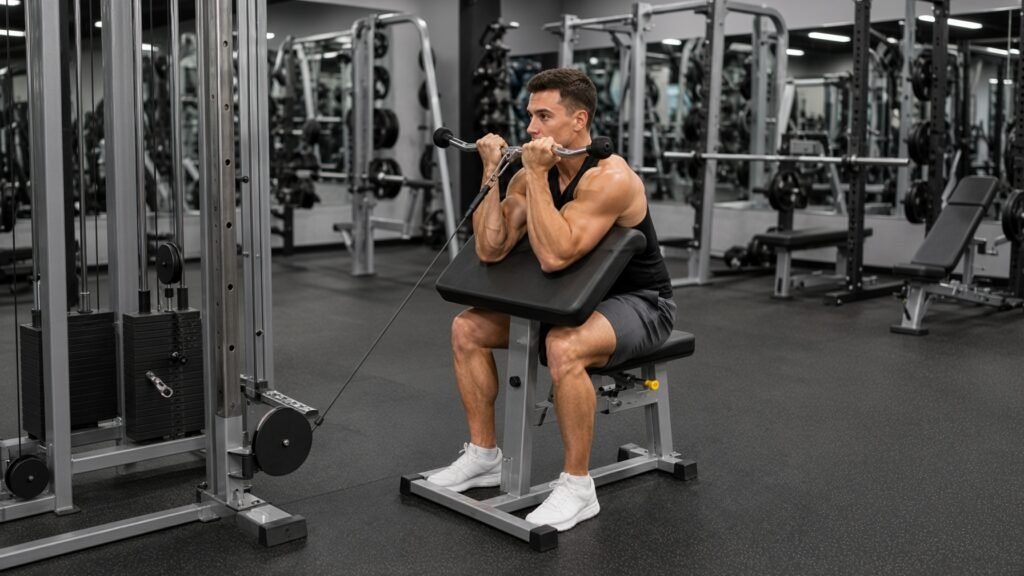
This is the one where cheating stops being an option.
Why it’s in here: The pad puts your arm out in front of your body, which shortens the long head and pushes the work onto the short head. It’s the opposite end of the range from the Bayesian curl, which is exactly why both are on the list.
How to do it: Set a preacher bench in front of a low pulley and attach a straight or EZ bar. Rest your upper arms flat on the pad with your armpits against the top edge. Curl the bar toward your face, then lower it until your arms are almost straight, keeping your triceps in contact with the pad the whole time.
Sets and reps: 3 sets of 10 to 12.
The mistake: Peeling your upper arms off the pad at the top. That turns it into a front raise and hands the work to your shoulders.
5. Overhead Cable Curl
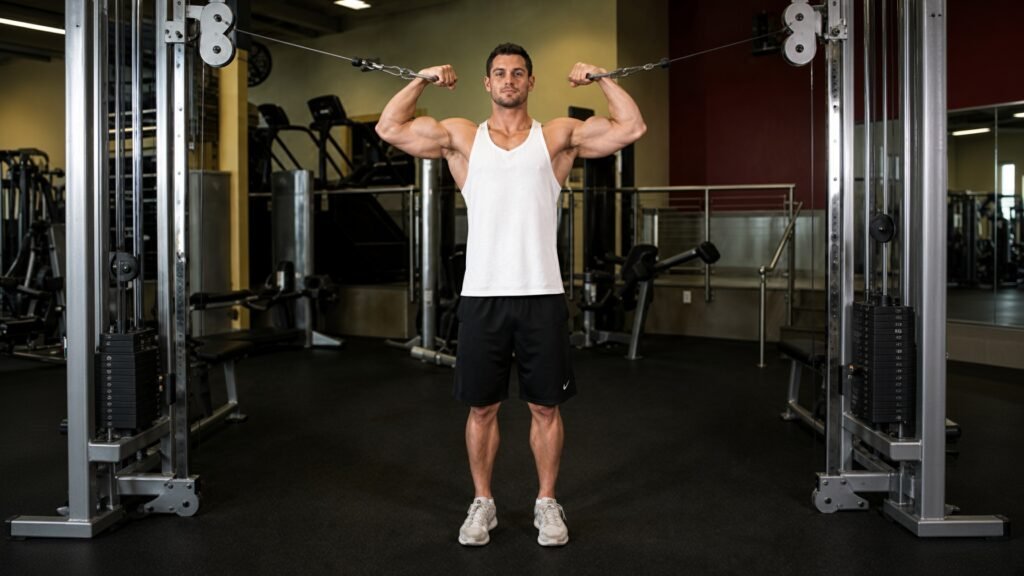
This is the one that looks like a pose, and it earns its place anyway.
Why it’s in here: With your upper arms out to the sides and your elbows high, the biceps finishes in a hard squeeze it doesn’t get anywhere else on this list. It’s the peak-contraction end of the range.
How to do it: Set both pulleys to shoulder height or a little above and take a handle in each hand. Stand in the middle with your arms out to the sides, palms facing up, elbows level with your shoulders. Curl your hands toward your ears without letting your elbows drop, hold the squeeze for a second, then straighten your arms under control.
Sets and reps: 2 to 3 sets of 12 to 15.
The mistake: Turning it into a shoulder movement by dropping your elbows as you curl. Your upper arms should stay exactly where they started.
6. Single-Arm Cable Curl
This is the one that finds the arm you’ve been quietly favoring.
Why it’s in here: One arm at a time means your stronger side can’t take over. Nearly everybody has a weaker arm, and if you only ever curl with both hands on a bar, you’ll never find out which one it is.
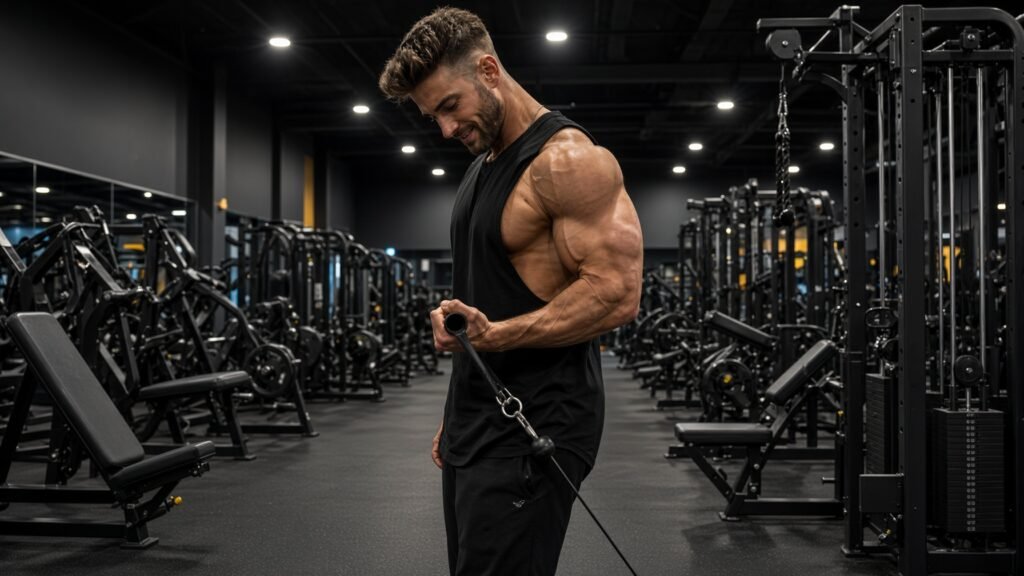
How to do it: Attach a single handle to the low pulley and take it in one hand with an underhand grip. Stand square, keep that elbow at your side, and curl the handle to your shoulder. Lower it all the way down. Do your weaker arm first and give your stronger arm the same number of reps, not the number it could do.
Sets and reps: 3 sets of 10 to 12 per arm.
The mistake: Leaning away from the machine to help the weight up. Stand still and let the arm do the work.
How to put these together
You don’t need all 6 in one session. Pick 3 or 4, cover more than one position, and train arms twice a week rather than once.
Session A: Bayesian cable curl, cable curl, cable hammer curl.
Session B: Cable preacher curl, single-arm cable curl, overhead cable curl.
Run those on two different days, ideally with a few days between them, and put them at the end of a session rather than the start. Biceps are small, and they recover fast, so twice a week beats one long arm day where the last few sets are junk.
One more thing worth knowing. Curls are one of the few exercises where training to actual failure is completely safe, because nothing lands on you. The worst that happens is the handle goes back down, and you look mildly annoyed. So on your last set of each exercise, go until the rep genuinely won’t move. You can’t do that on a bench press without a spotter, and it’s a real advantage of training arms on a cable.
How to actually add size over time
None of the 6 exercises above do anything on their own. What builds an arm is doing them with a little more work than last time, week after week. That’s progressive overload, and on a cable stack it has one specific problem.
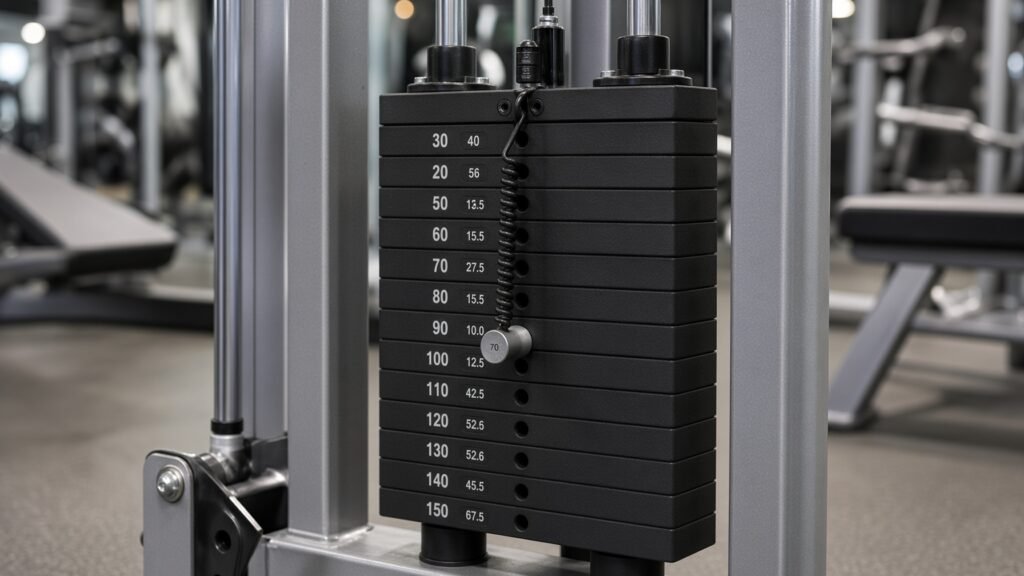
Cable stacks usually jump in 10 or 15 pound increments. On a squat that’s nothing. On a curl where you’re using 40 pounds, moving one plate is a 25 percent jump, and you’ll fail halfway through the set.
So do it in this order:
- Add reps before you add weight. If 3 sets of 8 is your starting point, work up to 3 sets of 12 at that same pin over a few weeks.
- Then move the pin and drop back to 8 reps. You’ll be stronger at the new weight than you were at the old one.
- Use the add-on plate if your gym has one. Most stacks have a small 2.5 or 5 pound plate that sits on top, and it turns an impossible jump into an easy one.
- Write it down. If you can’t say what weight and how many reps you did last week, you’re not overloading, you’re just visiting.
Do that for 3 months and the exercises above will have done what they’re supposed to do. Skip it and you can do perfect Bayesian curls forever and stay the same size.
Common questions
How often should I train biceps? Twice a week is the sweet spot for most people. Biceps are a small muscle, they recover in about 48 hours, and they get a lot of indirect work on any day you’re pulling. Once a week is enough to maintain but slow to build, and every day is just interfering with your own recovery.
Can I build good biceps with cables alone? Yes. The muscle responds to tension and progressive overload, not to what’s providing it. Cables give you more consistent tension than free weights, and they’re the only way to load the stretched position properly. If cables are all you have access to, you’re not missing anything important.
Should I go heavy or light on curls? Both, and it matters less than people think. Anywhere from 8 to 20 reps builds muscle as long as you’re taking the set close to failure. Heavier sets in the 8 to 12 range on the cable curl and preacher curl, higher reps in the 12 to 15 range on the overhead and hammer curls, and you’ve covered it.
Why do my forearms give out before my biceps? Because your grip is the limiter, not your arms. It’s most common on hammer curls and rope work. Do the grip-heavy exercises last, use a thicker rope if the gym has one, or use straps on your heaviest sets so the muscle you’re training is the one that fails first.
How long before I see a difference? With two sessions a week and actual progressive overload, expect to feel a difference in about 4 weeks and see one in 8 to 12. Arms are slower than people expect because they’re small and you’re starting from whatever you already have. Nobody adds an inch in a month, whatever the internet says.
Where to start
If you take one thing from this, take the Bayesian curl. Add it to your next arm session, put it first while you’re fresh, and give it 6 weeks. It’s the position your biceps have almost certainly never been trained in, and it’s the one your dumbbells can’t give you.
Then write down what you lifted, and beat it next week.
Readers Also Read